
 E-mail :
 Call Us :
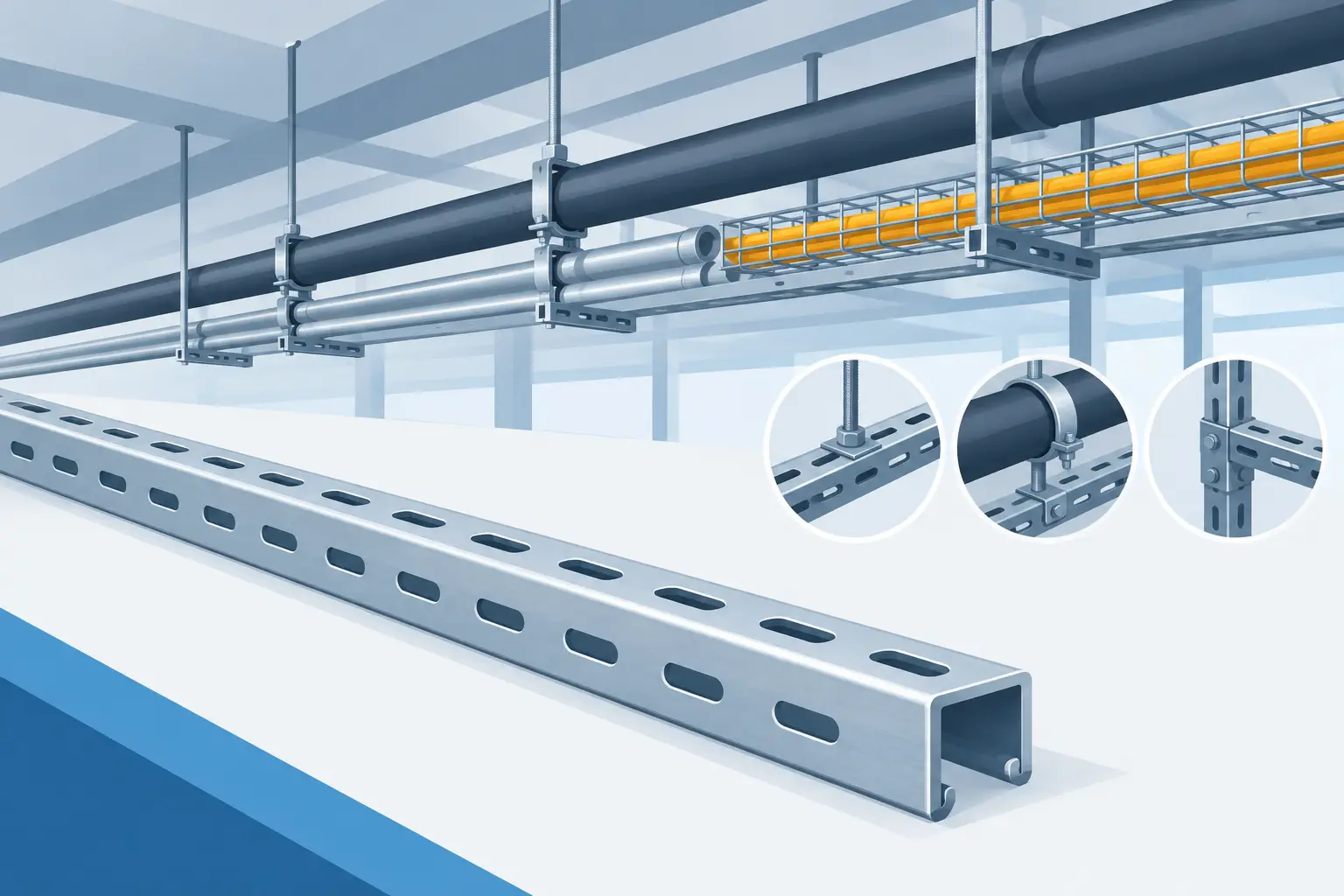
A 20-foot channel can reduce couplers, save installation time, and create cleaner continuous runs, but it also introduces freight, handling, and deflection considerations that shorter sections do not. When specifying uni strut 20 feet, procurement teams and engineers need more than a nominal length. They need the right profile, material thickness, finish, accessory compatibility, and delivery plan for the actual support system.
For electrical containment, HVAC supports, pipe racks, equipment frames, solar mounting structures, and industrial retrofits, long strut channel can be a practical choice. The value comes from designing and sourcing it as a complete system rather than treating the channel as an interchangeable commodity.
When Uni Strut 20 Feet Is the Right Choice
A 20-foot strut channel is most useful where uninterrupted support runs improve strength, alignment, or installation efficiency. Typical applications include long cable tray support lines, conduit racks, suspended pipe systems, machinery guards, and framing assemblies in warehouses or manufacturing plants.
The immediate advantage is fewer field connections. Each splice introduces hardware, labor, alignment checks, and a potential point of movement. A longer channel may eliminate one or more splices across a run, helping contractors maintain consistent elevation and spacing. It can also improve the appearance of exposed installations where straight, uniform framing matters.
That said, a 20-foot length is not automatically the most economical selection. A project with limited site access, restricted loading areas, or indoor installation routes may be better served by shorter pieces joined with properly specified fittings. The right decision depends on total installed cost, not only the per-foot channel price.
Start With the Channel Profile and Gauge
Strut systems are defined by more than length. Channel depth, flange geometry, slot pattern, and steel thickness determine how the section performs and which fittings it accepts. Standard shallow and deep profiles may look similar from a distance, yet their load behavior and accessory compatibility can differ significantly.
The channel gauge must suit the expected loading condition and span. Heavier-gauge channel generally provides greater stiffness and resistance to deformation, but it increases material weight, handling requirements, and shipping cost. A lighter profile may be appropriate for low-load conduit support, while a pipe rack or equipment frame can require a deeper, heavier section or a built-up assembly.
Slotted channel is often selected where installers need field adjustability. The slots allow threaded rods, spring nuts, and channel nuts to be positioned without drilling. Solid channel can be preferable where specific hole locations are required, where a cleaner appearance is desired, or where the engineering design calls for uninterrupted web material.
Before placing an order, confirm the exact profile dimensions, thickness tolerance, slot size and pitch, and compatible nut and fitting series. Terms such as “unistrut compatible” are useful commercially, but the dimensional requirement should still be documented in the purchase specification.
Load Capacity Requires an Engineered Check
Channel capacity cannot be determined from length alone. It depends on the channel section, steel grade, orientation, span between supports, connection method, concentrated versus distributed load, and allowable deflection. Corrosion loss over the service life and dynamic forces may also be relevant.
A 20-foot channel does not need to span 20 feet simply because it is supplied in that length. In most installations, it is supported at engineered intervals. The longer piece provides continuity across multiple support points, while the support spacing controls bending and deflection.
For critical installations, the project engineer should verify the complete assembly: channel, brackets, threaded rod, beam clamps, channel nuts, anchors, and supporting structure. Using a heavy channel with undersized fittings does not produce a dependable system. Every component must be matched to the governing load path.
Material and Finish Should Match the Environment
The operating environment should drive the material and finish decision early in the sourcing process. Mild steel with a pre-galvanized or electro-galvanized finish can be suitable for dry indoor locations. Hot-dip galvanized channel is commonly specified for outdoor, industrial, and damp-service applications where more substantial corrosion protection is needed.
Stainless steel is often justified in food processing, wastewater, marine, chemical, and coastal environments. It has a higher initial cost, but can reduce maintenance and replacement risk where corrosion would compromise safety or uptime. Aluminum strut can provide a useful weight advantage and corrosion resistance in selected applications, although its strength, connection behavior, and galvanic compatibility must be reviewed.
Mixed-metal assemblies deserve special attention. Stainless hardware against galvanized steel, aluminum framing near copper components, and wet marine exposure can create corrosion concerns if the material combination is not properly managed. The finish should be specified for the installed environment, not selected solely based on availability.
Freight and Handling Are Part of the Specification
Long channel changes the logistics plan. A 20-foot section requires suitable truck length, secure bundling, unloading equipment, and a protected staging area. It may not fit standard parcel or small LTL handling practices, and the risk of bending or surface damage rises when bundles are improperly supported during transit.
Procurement teams should confirm bundle quantities, bundle weight, packaging method, maximum piece length, and unloading responsibility before release. For export shipments, the plan should also address container loading, blocking and bracing, moisture protection, marking, and documentation. These details are operational requirements, not afterthoughts.
At the job site, installers need a safe method to move the channel without twisting it or damaging the finish. A long piece can be awkward even when its individual weight seems manageable. Staging the channel close to the installation zone can reduce unnecessary movement and improve crew productivity.
Specify the Complete Strut Support Package
Channel availability alone does not keep a project moving. A complete purchase package should account for the fittings and hardware needed to install the system without substitutions or field improvisation. For a typical long-run support system, that may include channel nuts, bolts, washers, splice plates, angle fittings, post bases, beam clamps, threaded rods, pipe clamps, and seismic bracing components where required.
Compatibility is especially important when the project uses existing strut infrastructure. Verify nut spring dimensions, fitting hole patterns, channel lip geometry, and coating compatibility before combining products from different sources. A component that appears interchangeable can create installation delays if tolerances are inconsistent.
For repeat programs and OEM assemblies, custom punched holes, controlled cut lengths, welded brackets, or special finishes can reduce downstream fabrication. This approach may be more efficient than purchasing stock channel and modifying it after delivery, particularly when the same configuration is installed across multiple sites.
What to Include in Your RFQ for 20-Foot Strut
A well-prepared request for quotation avoids clarification cycles and helps suppliers quote accurately. Include the channel profile drawing or dimensional standard, material grade, gauge, required length, slot configuration, finish, estimated quantity, and destination. State whether full 20-foot lengths are mandatory or whether equivalent cut lengths are acceptable.
Also identify the application, expected loading information, inspection requirements, packaging expectations, and required delivery date. If the channel must integrate with an existing system, provide the mating component dimensions or a physical sample when practical. For custom work, a controlled drawing revision and clear acceptance criteria are essential.
Metallix Exports supports B2B buyers with standard strut-compatible components and custom fabricated support hardware, helping consolidate channel, fittings, brackets, and related metalwork under a production-focused supply program. Consistent dimensions, controlled fabrication, and export-ready packaging help reduce avoidable risk across project procurement.
A 20-foot channel is most effective when its length, section, finish, accessories, and logistics are treated as one engineered supply decision. Specify the system clearly at the start, and the installation team can spend its time building the support structure rather than solving preventable fit-up problems in the field.