
 E-mail :
 Call Us :
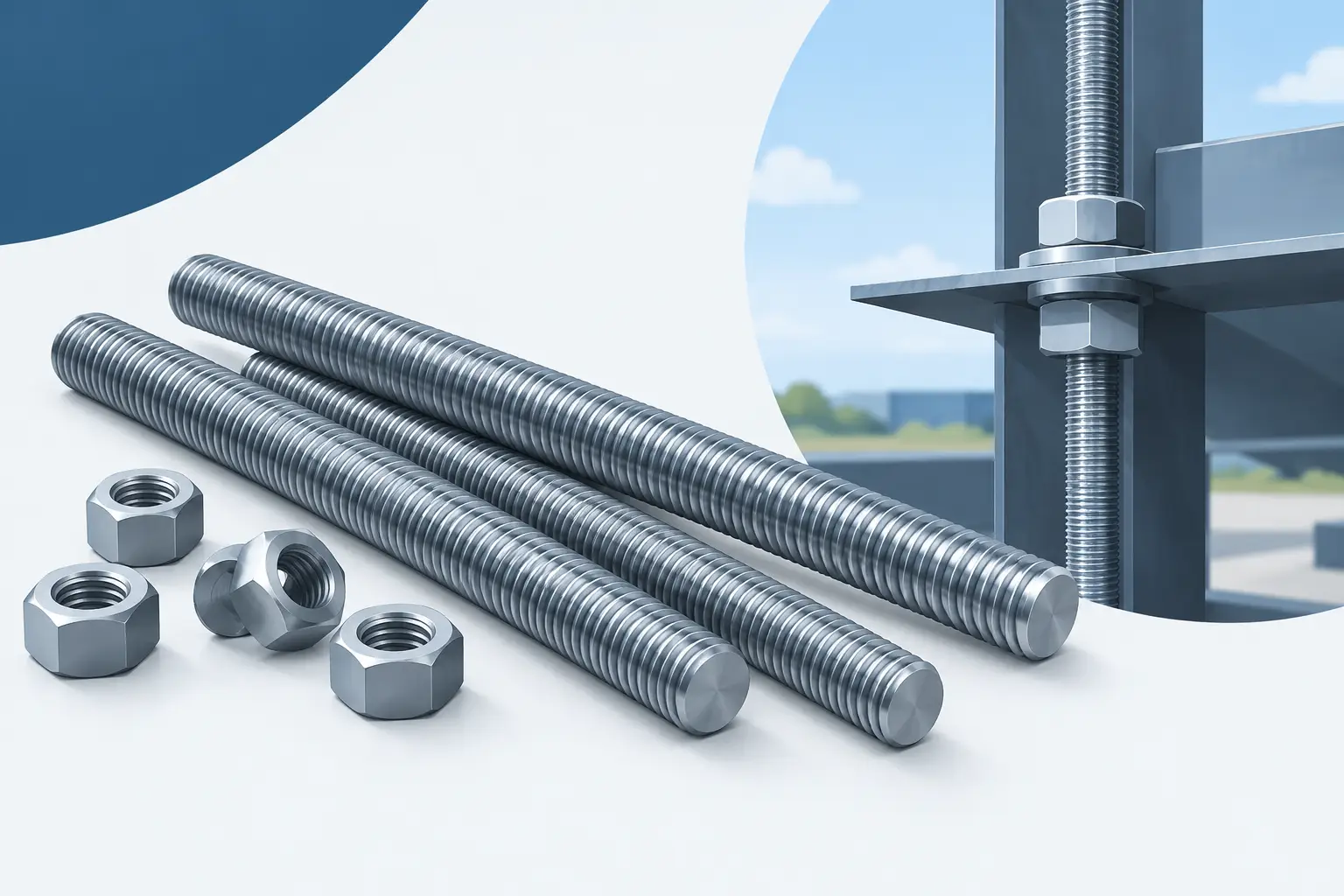
A 3/8-inch rod can be a small line item on a bill of materials, but it often carries a large share of installation risk. Threaded rods 3/8 are regularly used to suspend HVAC equipment, secure strut assemblies, support cable management, join fabricated frames, and create adjustable connections in commercial and industrial work. When the thread, grade, coating, or cut length is wrong, the result is rarely a minor inconvenience. Crews lose time, components do not seat correctly, and procurement must solve a preventable shortage under project pressure.
For buyers, engineers, and contractors, the right specification starts with treating threaded rod as an engineered connection component rather than a commodity. The rod must match the load path, mating hardware, environment, installation method, and documentation requirements of the assembly.
What threaded rods 3/8 mean in practice
In standard North American hardware, 3/8 typically refers to the nominal outside diameter of the rod. The most common configuration is 3/8-16 UNC, meaning 16 threads per inch in the Unified National Coarse thread series. It is widely available and works with compatible nuts, couplings, washers, channel nuts, and other 3/8-16 hardware.
That commonality is useful, but it should not replace verification. A 3/8-inch rod may be supplied with different thread series, material grades, coatings, end treatments, or length tolerances. Coarse threads are generally preferred for typical structural support and field assembly because they install quickly and tolerate normal jobsite conditions well. Fine threads may suit applications requiring more precise adjustment or specific engineering requirements, but they must never be mixed with coarse-thread hardware.
A purchasing description such as “3/8 threaded rod” may be enough for a maintenance purchase. For repeat production, export programs, or safety-relevant support systems, it leaves too much open to interpretation. Specify the full thread callout, material, grade or mechanical property requirement, finish, length, and packaging expectation.
Select the material for the actual exposure
Material selection should begin with the service environment, not just the initial purchase price. Carbon steel threaded rod is a practical choice for dry, indoor applications where a suitable protective finish is used. It is commonly specified for general framing, overhead support, equipment mounting, and mechanical installations.
Zinc-plated carbon steel provides a basic level of corrosion resistance for indoor use and controlled environments. It is not a universal answer for persistent moisture, chemical exposure, or coastal air. Where corrosion protection must withstand more demanding conditions, hot-dip galvanized rod is often considered. Its heavier zinc coating can provide stronger long-term protection, though coating thickness can affect thread fit. Nuts and couplers must be selected to suit galvanized threads rather than assumed interchangeable with standard plated hardware.
Stainless steel is often the better choice for washdown areas, outdoor installations, food-related environments, marine work, and corrosive industrial settings. The specific stainless grade still matters. A grade suitable for ordinary outdoor conditions may not be sufficient near saltwater or in chemical processing areas. Buyers should also consider galling, particularly with stainless steel nuts and rods. Appropriate lubrication, compatible hardware, and controlled installation torque can reduce the risk of thread seizure.
Aluminum and other nonferrous threaded components may be appropriate where weight, electrical conductivity, or material compatibility drives the design. Their lower strength compared with many steel options must be accounted for in the engineering review.
Grade is not a label to overlook
A rod's nominal diameter does not indicate its load capacity. Mechanical performance depends on the material specification, heat treatment where applicable, thread geometry, condition of the rod, and how the connection is assembled. Low-carbon threaded rod, medium-strength commercial rod, and higher-strength alloy steel products can have materially different tensile and yield properties.
The assembly design also affects usable capacity. Thread engagement length, nut grade, washers, eccentric loading, vibration, anchor design, and support spacing all matter. A rod used in straight tension is not evaluated the same way as a rod exposed to bending, side loading, or repeated movement. For engineered supports, seismic restraints, overhead systems, and critical equipment connections, use the project engineer's approved design values and applicable code requirements rather than relying on a generic catalog rating.
Getting length right reduces field cutting and waste
Threaded rod is valued for adjustability, but excessive field cutting creates avoidable labor and quality issues. Burrs from rough cuts can damage nuts, create sharp edges, and slow installation. Cut lengths should allow for the required engagement at each end, washers and hardware thickness, adjustment range, and any projected thread required by the assembly.
For suspended systems, calculate the rod length from the finished elevation rather than from a nominal ceiling or deck dimension. Account for the attachment fitting, strut channel depth, trapeze configuration, equipment clearance, and leveling adjustment. On fabricated frames, check whether the rod must extend beyond a nut for locking, inspection, or attachment of an additional component.
When specifying pre-cut rods, define the length measurement basis and tolerance. This is especially valuable for OEM kits and repeated installations, where every unnecessary cut becomes a source of variation. Metallix Exports can support standardized and custom hardware requirements with production discipline suited to repeatable assemblies and export-ready supply programs.
Match threads and mating hardware before production begins
Most field failures involving threaded rod are not failures of the rod itself. They are compatibility failures. A nut with the wrong pitch will appear to start, then bind or damage the threads. A coupler may have insufficient engagement depth. A channel nut may fit the strut profile but not meet the required load or coating specification.
Confirm that all mating hardware uses the same thread designation. For a 3/8-16 UNC rod, specify compatible 3/8-16 UNC nuts, couplings, and accessories. If the assembly includes metric components, do not assume that a near-equivalent metric thread will fit. Similar diameters can still have different pitches and thread forms.
Thread engagement deserves equal attention. As a general installation principle, adequate engagement should be provided to develop the intended connection performance, with the exact requirement determined by the material, grade, and design. A nut that only catches a few threads is not an acceptable substitute for the correct length or coupling configuration.
Finish and quality control protect project schedules
Surface finish is both a corrosion-control decision and a supply-chain decision. It should be documented clearly across the rod, nuts, washers, couplings, and fabricated brackets used in the same assembly. Mixing finishes without review can create inconsistent corrosion performance and, in certain environments, galvanic compatibility concerns.
For B2B procurement, a complete specification should identify these points:
- Nominal diameter and complete thread designation, such as 3/8-16 UNC
- Material and mechanical grade or required performance standard
- Finish, including zinc plating, hot-dip galvanizing, stainless grade, or other approved treatment
- Overall length, cut-length tolerance, and any chamfering or end-finish requirement
- Required mating hardware, packaging quantity, traceability, and inspection documentation
Dimensional checks should verify diameter, thread form, pitch, straightness, length, coating coverage, and ease of assembly with approved nuts. For custom-cut or fabricated packages, quality control should also confirm count accuracy and labeling. These checks are straightforward, but they prevent the kind of jobsite discovery that delays installation crews and disrupts downstream work.
When standard stock is not enough
Standard 3/8-inch rod is efficient when the application is ordinary and quantities are flexible. Custom supply becomes more valuable when a project requires fixed cut lengths, bundled hardware kits, specific materials, nonstandard finishes, special packaging, or integration with brackets, channels, clamps, and welded fabrications.
A single manufacturing partner can simplify this process by coordinating the threaded rod with the fabricated components it will support. That reduces mismatched tolerances between separately sourced items and gives procurement teams a clearer path for inspection, packaging, and shipment planning. For international projects, packaging strength, labeling, and export documentation are practical details that deserve early attention, not last-minute correction.
Before releasing a purchase order, review a physical sample or approved drawing for any assembly that is repeated at scale. A few minutes spent checking thread fit, coating, length, and hardware stack-up can prevent a far more expensive correction after materials reach the site. The best 3/8-inch threaded rod is not simply the one that arrives first - it is the one that installs cleanly, performs as specified, and keeps the entire assembly moving forward.