
 E-mail :
 Call Us :
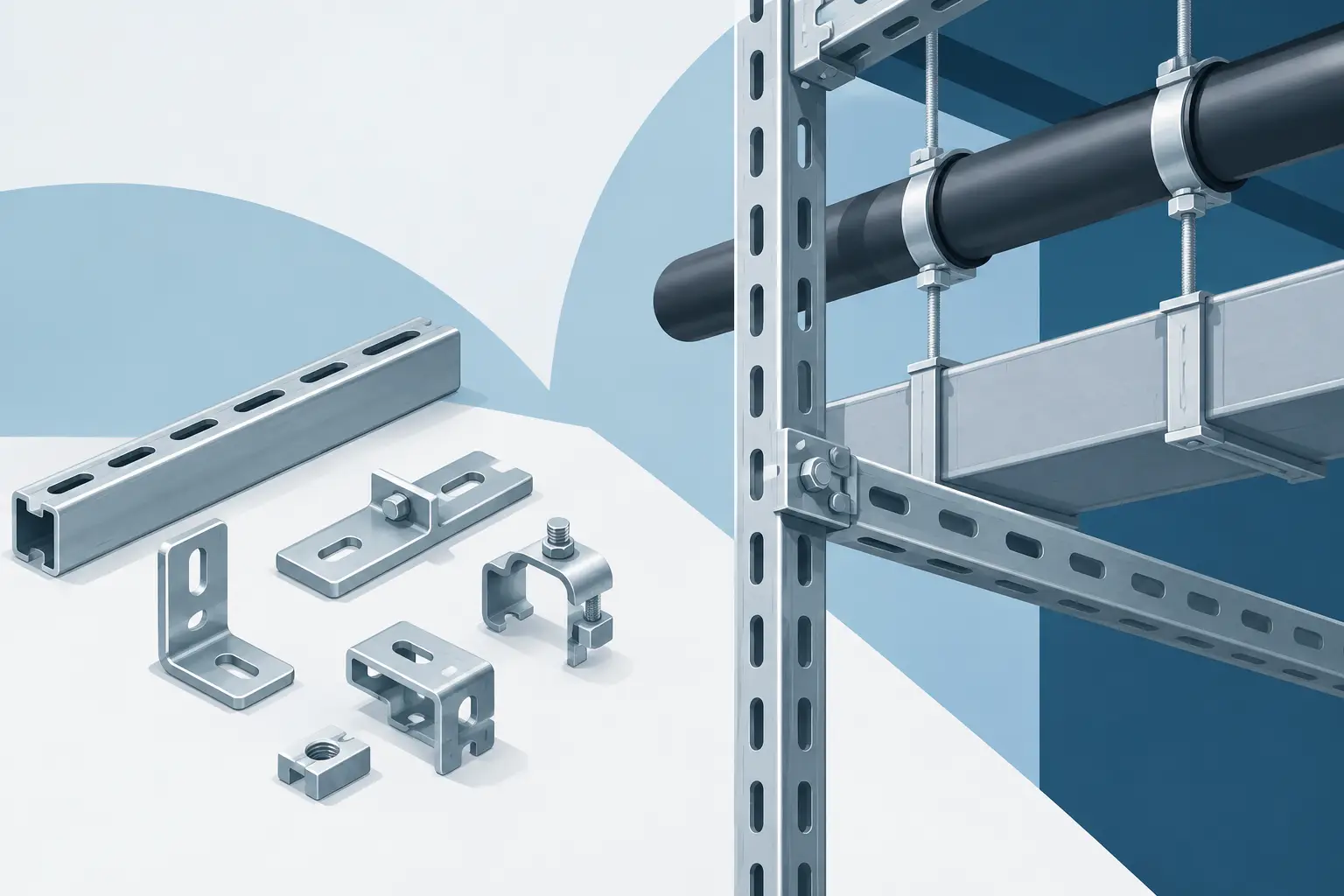
A strut channel system is only as dependable as the connection points that hold it together. Strut fittings create those connections, joining channel sections, supporting threaded rod, forming frames, and anchoring assemblies to walls, ceilings, floors, and structural members. For contractors, OEMs, and procurement teams, selecting the right strut fittings affects installation speed, load performance, corrosion resistance, and long-term serviceability.
What Strut Fittings Do in a Support System
Strut fittings are formed or fabricated metal components designed to work with slotted strut channel. Common examples include angle fittings, flat plates, corner brackets, post bases, beam clamps, channel nuts, spring nuts, U-bolts, pipe clamps, and threaded-rod hardware. Together, they allow installers to build adjustable support structures without field welding or extensive drilling.
That flexibility is the central advantage of a channel-based system. A support frame can be modified during installation, expanded for additional equipment, or reconfigured when layouts change. In electrical, HVAC, plumbing, data center, industrial machinery, solar, and commercial construction work, that adaptability can reduce labor and simplify future maintenance.
The fitting itself is not a minor accessory. It transfers load from one component to another, maintains alignment, and determines whether a support assembly can resist vibration, movement, and environmental exposure. A poorly matched fitting may appear acceptable at installation but create clearance issues, galvanic corrosion, slippage, or reduced capacity over time.
Selecting Strut Fittings Starts With the Application
The right specification depends on what the system supports and where it will operate. A light-duty cable tray support inside a conditioned facility has different requirements from a rooftop HVAC rack, a marine-adjacent installation, or an industrial production line subject to vibration.
Start with the channel profile. Many projects use unistrut-compatible channel dimensions, but compatibility should never be assumed from a product description alone. Channel width, slot pattern, material thickness, lip geometry, and nut engagement all influence fit. Confirm the dimensions of both the channel and fitting before ordering, particularly when products from multiple manufacturers will be used in the same assembly.
Load direction matters as much as total weight. A fitting may handle a vertical hanging load effectively while being less suitable for side loading, cantilevered arms, or torsional forces. Brackets supporting conduit, pipe, cable tray, or equipment should be evaluated as part of the complete assembly, including channel span, fasteners, anchors, threaded rod, and connection points.
For engineered installations, published load data and project-specific calculations should guide the final design. Material thickness alone is not a reliable indicator of capacity. Hole placement, bends, weld configuration, steel grade, fastener selection, and the distance between supports all affect real-world performance.
Material and Finish Affect Service Life
Material selection should reflect the operating environment, not just initial purchase cost. Mild steel fittings are commonly used for indoor commercial and industrial work where exposure is limited. They provide practical strength, economical sourcing, and broad compatibility with standard channel systems.
Galvanized steel is often specified where moisture, outdoor exposure, or moderate corrosion risk is expected. The appropriate galvanizing method depends on the product, required coating coverage, expected service conditions, and project specifications. Pre-galvanized material can be suitable for many applications, while hot-dip galvanized components may be preferred for more demanding exterior environments.
Stainless steel strut fittings are a stronger choice for washdown areas, food processing, chemical exposure, coastal sites, and marine applications. Grade selection still matters. Stainless steel does not make every corrosion concern disappear, especially where chlorides, dissimilar metals, trapped moisture, or chemical residues are present.
Aluminum components can reduce weight and perform well in certain corrosive environments, but they have different strength characteristics and require careful consideration when joined to steel hardware. Copper and specialized alloys may also be needed for electrical or application-specific requirements. The best choice is the one that balances environmental resistance, mechanical needs, compatibility, and project budget.
Common Fitting Types and Their Roles
Angle fittings are used to form 90-degree connections, braces, and equipment supports. Their configuration can range from simple one-hole angles to multi-hole structural brackets that allow adjustment along both channel axes. Flat plates join channel sections in line or provide a mounting surface where a larger contact area is needed.
Post bases and base plates secure vertical channel members to concrete, steel, wood, or fabricated frames. Their design must suit the intended anchor type and loading condition. Beam clamps and channel clamps attach assemblies to existing structural members when drilling or welding is not practical or permitted.
Channel nuts, spring nuts, and square nuts provide the threaded connection inside the strut channel. These small components are frequently overlooked, yet they are essential to installation efficiency and connection performance. Spring-assisted nuts help hold position during assembly, which can be especially useful for overhead work and multi-component frames.
Pipe clamps, conduit clamps, U-bolts, and threaded rod accessories complete the support arrangement. Their sizing must match the supported item and account for insulation thickness, thermal movement, vibration, and access for tightening. Selecting hardware as a coordinated system reduces the risk of mismatched threads, inadequate clearances, or inconsistent finishes.
Why Hole Patterns and Tolerances Matter
In strut support work, a few millimeters can determine whether an assembly installs cleanly or requires costly field modification. Hole diameter, center-to-center spacing, slot length, bend angle, and channel engagement all need to be controlled consistently.
For repeat production, precise tolerances support faster installation and predictable interchangeability. This is particularly valuable for OEMs building modular equipment skids, electrical enclosures, machine guards, racking accessories, or prefabricated support packages. When every bracket aligns with the intended channel and fastener pattern, crews spend less time correcting parts on site.
Custom strut fittings are often the practical answer when standard catalog items do not address a specific offset, hole pattern, mounting interface, or load path. A custom part should not simply replicate a field-made modification. It should be designed for manufacturability, material efficiency, repeatable forming, and the actual installation method.
Manufacturing Considerations for Custom Fittings
A capable fabrication partner can convert a sketch, drawing, sample, or established specification into production-ready hardware. The process may include laser cutting, punching, bending, welding, forming, tapping, assembly, and surface finishing. The correct manufacturing route depends on quantity, geometry, material, and dimensional requirements.
Punching is efficient for repeat hole patterns and higher-volume production. Laser cutting offers flexibility for complex profiles, prototype runs, and evolving designs. Press brake forming creates accurate angles and offsets, while welding can add gussets, mounting tabs, or multi-part structural features. Secondary operations such as deburring, threading, and protective coating preparation help ensure that fittings arrive ready for their intended application.
Material traceability, inspection procedures, and packaging also deserve attention. Industrial buyers need parts that remain identifiable through receiving and installation, arrive protected from transit damage, and maintain consistent quality across batches. For export projects, packaging must also account for long-distance handling, moisture exposure, and destination-specific shipping requirements.
Metallix Exports supports standard and custom metal hardware programs with precision fabrication capabilities across steel, stainless steel, aluminum, and other application-appropriate materials. This approach helps buyers consolidate compatible channel hardware, brackets, clamps, and fabricated support components with one manufacturing partner.
Avoiding Costly Specification Gaps
The lowest unit price is not always the lowest installed cost. A fitting that requires drilling, shimming, rework, or special fasteners can quickly increase labor costs and delay a project. Similarly, an unsuitable finish may require premature replacement in a corrosive environment.
Purchasing teams should provide the channel profile, material requirement, coating or finish, hole pattern, thickness, quantity, target application, and required documentation at the quotation stage. If the fitting supports a critical load, include applicable drawings, expected load conditions, anchor information, and any governing standards or customer specifications.
It also helps to separate requirements that are fixed from those that remain flexible. A specific mounting interface may be non-negotiable, while material thickness or manufacturing method may allow alternatives that improve lead time or cost. Early engineering review makes these trade-offs visible before production begins.
Build the Connection for the Conditions It Will Face
Effective strut systems are built from compatible components, accurate dimensions, and materials suited to the job site. Whether the need is a standard angle bracket, a heavy-duty post base, a corrosion-resistant clamp, or a custom fabricated connection, the fitting should be evaluated as part of the entire support path. Clear specifications and disciplined manufacturing give installers hardware that fits properly, performs reliably, and remains practical to maintain long after the original installation is complete.