
 E-mail :
 Call Us :
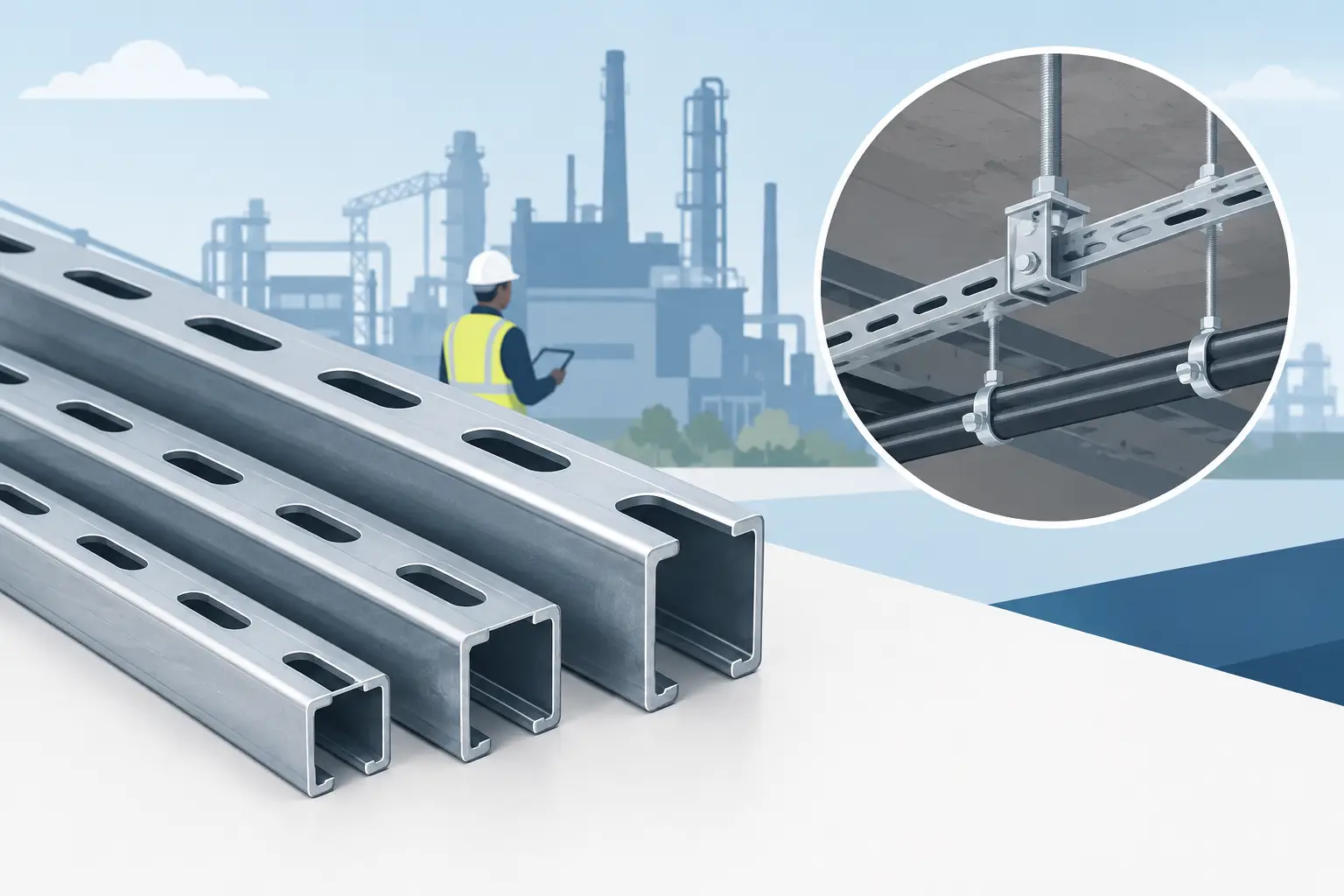
A strut channel system may look straightforward on a drawing, but its performance depends on details that are easy to overlook: profile depth, steel thickness, corrosion exposure, fitting geometry, anchor selection, and the actual load path. For procurement teams, contractors, and OEMs, choosing the right system is less about buying a length of channel and more about building a support assembly that installs efficiently and performs reliably over its service life.
What Strut Channel Does in a Support System
Strut channel is a cold-formed metal framing profile used to create adjustable structural supports without field welding. It is widely specified for pipe racks, cable tray supports, HVAC equipment, electrical containment, solar mounting substructures, machine guarding, and general industrial framing.
The channel’s inward-facing lips accept channel nuts, spring nuts, bolts, and purpose-made fittings. That simple interface allows installers to position brackets and connections along the channel length, make adjustments in the field, and assemble frames with common hand tools. When project conditions change, the system can often be reconfigured rather than cut out and rebuilt.
That flexibility is valuable, but it should not be confused with unlimited capacity. A channel frame is only as capable as its weakest element. The channel profile, span, connection hardware, bracket orientation, base attachment, and applied loading all need to be considered together.
Selecting the Right Strut Channel Profile
The first decision is the profile itself. Standard channel widths and depths are common, but dimensions vary by manufacturer and product family. Deep profiles generally provide higher bending capacity than shallow profiles, while heavier gauges improve resistance to deflection and local deformation around connections.
Solid channel is often preferred where maximum section strength is needed or where slot locations would not provide a functional benefit. Slotted channel reduces weight and provides additional attachment positions, which can speed installation. The trade-off is that slots affect the section and may reduce capacity compared with an equivalent solid profile. A specification should therefore identify the required profile, material thickness, slot pattern, and allowable load rather than simply calling for “strut.”
Back-to-back channel assemblies are used when a single channel cannot carry the required load or when greater torsional stability is needed. This arrangement can be effective for trapeze supports, equipment frames, and longer spans, but it requires properly matched connectors and a clear understanding of how the built-up section will be loaded.
Load Ratings Require Real Application Data
Catalog load tables are useful starting points, not a substitute for application review. They commonly assume specific support conditions, span lengths, loading direction, and safety factors. A channel loaded vertically between two supports behaves differently from a cantilever bracket or a frame subject to side load, vibration, or repeated movement.
For a dependable specification, define the total supported weight, point-load locations, support spacing, anticipated dynamic forces, and environmental conditions. Pipe systems also introduce considerations such as thermal movement, fluid weight, insulation, and seismic restraint requirements. Where the consequences of failure are significant, the design should be reviewed by the responsible engineer.
Material and Finish Choices Matter
Material selection should reflect both load requirements and the operating environment. Mild steel is a practical, cost-effective choice for many interior industrial installations. It offers good formability and weldability, making it suitable for standard channel, brackets, and custom fabricated frames.
Pre-galvanized steel is commonly used for indoor or protected applications where moderate corrosion resistance is required. The coating provides a useful level of protection, though cut edges, drilled holes, weld areas, and prolonged moisture exposure need careful consideration. Hot-dip galvanized steel provides a heavier protective coating and is generally better suited to outdoor construction, utility work, and damp or corrosive environments.
Stainless steel is often selected for food processing, pharmaceutical, marine, wastewater, chemical, and coastal applications. It brings higher corrosion resistance, but grade selection still matters. A stainless grade appropriate for a dry plant interior may not be sufficient near chlorides, salt spray, or aggressive washdown chemicals. Aluminum can reduce weight and offers good corrosion performance in many settings, although its lower stiffness, galvanic compatibility, and connection requirements must be evaluated.
Finish is not an afterthought. A coating should be selected based on the complete system environment, including fittings, fasteners, clamps, and anchors. Combining dissimilar metals without considering galvanic corrosion can create a problem that is not visible at installation but becomes costly in service.
Fittings and Hardware Define the Assembly
A strut support system depends on more than channel lengths. Angle fittings, flat plates, post bases, beam clamps, cantilever arms, pipe clamps, channel nuts, threaded rod, and bolts turn individual components into a functional structure. Standardized hardware supports fast assembly and repeatable results, particularly on projects with many similar installations.
Compatibility is essential. Unistrut-compatible dimensions can simplify replacement and allow buyers to integrate channel and hardware with established installation practices. However, “compatible” should be verified against the required dimensions, lip geometry, thread size, material, and load rating. A nut that fits the opening is not automatically suitable for the connection demand.
Fastener choice deserves the same attention as the framing. Thread engagement, bolt grade, washer selection, torque requirements, and corrosion resistance influence connection reliability. For vibration-prone equipment or mobile applications, locking methods and inspection access may be necessary. For overhead installations, anchor type and substrate condition are particularly critical.
When Standard Channel Is Not Enough
Standard components are efficient when the application matches common support layouts. Custom fabrication becomes valuable when a project needs nonstandard hole patterns, special lengths, welded assemblies, reinforced brackets, unusual offsets, or material and coating combinations that are not readily available from stock.
For OEMs, a fabricated strut-based assembly can reduce field labor and simplify inventory. Instead of sourcing channel, plates, brackets, hardware, and secondary fabrication separately, buyers can receive a prepared kit or assembled frame built to an approved drawing. This approach also improves consistency across repeated installations.
Custom work should begin with clear inputs: drawings, critical dimensions, material grade, thickness, finish, load requirements, mating parts, packaging needs, and inspection criteria. Tight tolerances are valuable where interfaces demand them, but they should be applied purposefully. Over-specifying tolerances can increase cost without improving system performance.
Metallix Exports supports standard and custom metal hardware requirements with precision cutting, punching, bending, welding, forming, assembly, and surface-finishing capabilities. For international buyers, coordinated production and export-ready packing can also reduce the complexity of managing multiple component suppliers.
Common Specification Mistakes to Avoid
Many support issues originate before fabrication or installation begins. The most common mistake is specifying only the channel size while leaving material, coating, fittings, and design loads undefined. That invites substitutions that may fit physically but perform differently in service.
Another frequent issue is using a corrosion-resistant channel with unprotected hardware. The system will typically deteriorate where its least-resistant components are located. Buyers should specify a coordinated material and finish strategy for the full assembly.
Installation assumptions can also create problems. Field crews need access to tighten fasteners, adequate clearance for channel nuts and clamps, and a practical sequence for adding equipment. A technically sound frame can still be difficult to install if it has not been reviewed from the installer’s perspective.
Finally, avoid treating load capacity as a single number. A bracket may have a published rating, but that rating can change with arm length, channel orientation, fastener spacing, or the substrate supporting the assembly. The details determine the result.
A Better Procurement Approach for Strut Support Systems
A reliable purchase package gives suppliers enough information to quote accurately and manufacture consistently. Start by identifying the application and operating environment. Then define profile dimensions, material, finish, required fittings, fastener sizes, quantities, drawing revisions, packaging expectations, and delivery milestones.
For recurring programs, establish approved samples and inspection checkpoints early. Dimensional checks, coating verification, thread tests, weld inspection, and packaging review can prevent repeat issues across larger production runs. Procurement teams benefit from consolidating related components where possible, but only when the supplier has the manufacturing controls to maintain quality across the full scope.
The best strut channel solution is rarely the heaviest or the least expensive option. It is the system that matches the actual load, environment, installation method, and project schedule with enough precision to perform as intended. Clear specifications and capable fabrication turn a familiar channel profile into dependable infrastructure.