
 E-mail :
 Call Us :
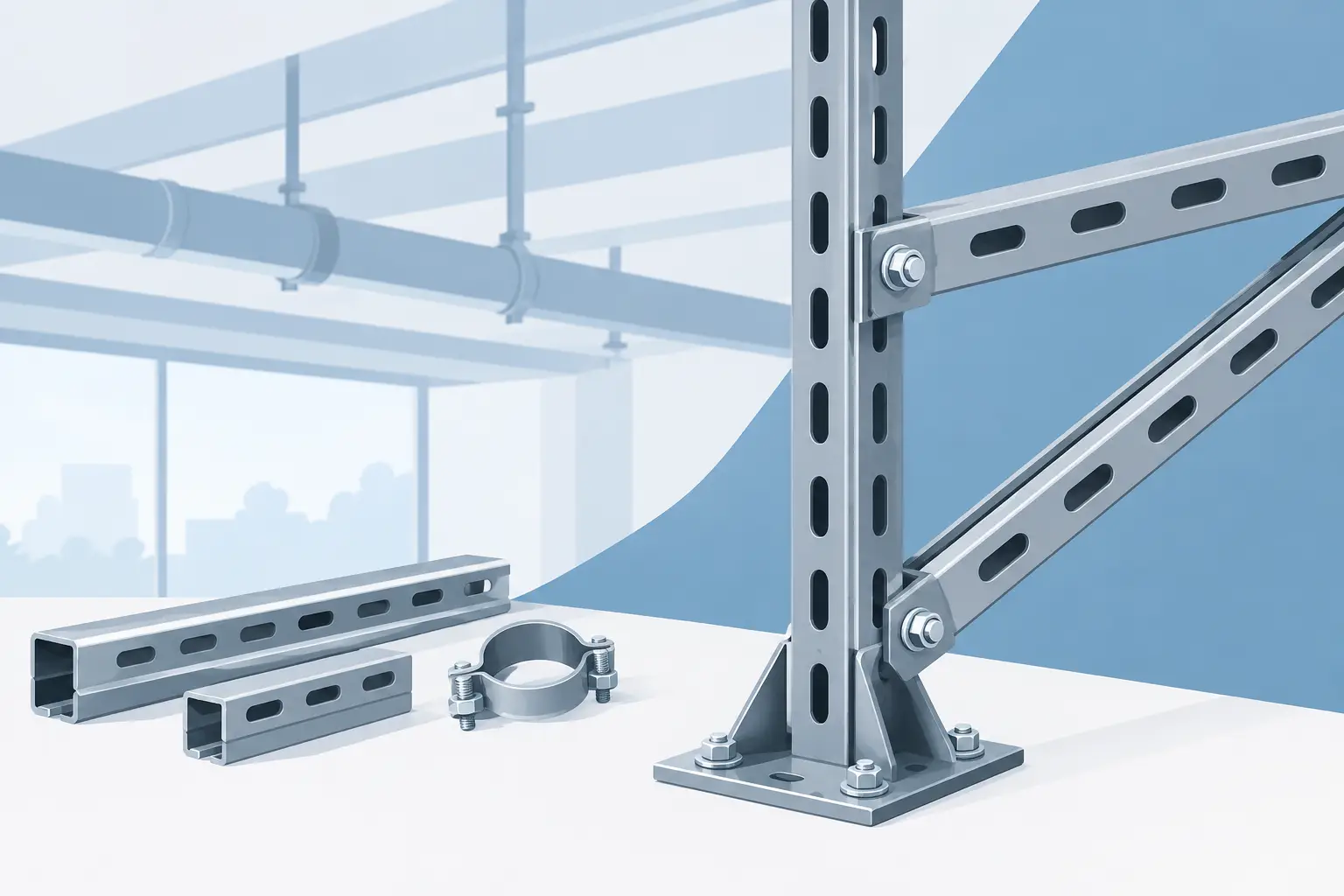
A support system can look straightforward on a drawing and become complicated quickly in the field. Strut assemblies must carry the intended load, fit surrounding services, tolerate the environment, and remain practical for installers to adjust. For procurement teams, engineers, and contractors, the right assembly is not simply a collection of channel and fittings. It is a coordinated hardware solution that affects installation speed, long-term reliability, and project cost.
What Makes Up a Strut Assembly?
A typical strut assembly begins with metal channel, commonly produced in standard or slotted profiles. The channel creates a continuous mounting surface for spring nuts, bolts, clamps, brackets, and other fittings. This modular arrangement allows support locations to be positioned and adjusted without field welding or extensive drilling.
The final assembly may include channel lengths, angle fittings, flat plates, post bases, beam clamps, pipe clamps, threaded rod, fasteners, and protective end caps. The exact combination depends on what is being supported and where it is installed. A cable tray run, for example, has different loading and clearance requirements than an HVAC pipe rack or a machine guard frame.
Compatibility matters throughout the system. Unistrut-compatible channel dimensions and fittings help buyers integrate components with established designs while retaining sourcing flexibility. However, compatibility should not be assumed from appearance alone. Slot geometry, material thickness, fitting hole patterns, thread sizes, and tolerances should be confirmed before production or purchase.
Start With the Load Path, Not the Parts List
The most common specification mistake is selecting individual components before defining how force moves through the full structure. Every assembly needs a clear load path: from the supported equipment or service, through clamps and fittings, into the channel, then through anchors, rods, or bases into the building structure or foundation.
This approach identifies where additional capacity may be required. A heavy load may be adequately supported by the channel itself but place excessive demand on a connection plate, threaded rod, anchor, or weld. A long span can introduce channel deflection even when the total load seems modest. Eccentric loading, vibration, seismic requirements, wind exposure, and repeated equipment movement can also change the appropriate design.
Engineering teams should define the supported load, span, support spacing, orientation, connection method, and required safety factors. Procurement teams can then request a quote against clear requirements rather than comparing component prices that may not represent equivalent capacity.
Channel Profile and Material Thickness
Channel selection affects both strength and assembly flexibility. Shallow profiles can work well for lighter wall-mounted services and constrained spaces. Deeper channel profiles generally offer greater section strength for trapeze supports, equipment frames, and longer spans. Back-to-back channel configurations may be appropriate when a higher-capacity structural member is needed.
Material thickness is equally significant. Two channels with similar outside dimensions may perform differently if gauge, steel grade, or forming quality differs. Consistent material selection and controlled forming help ensure that channel sections accept fittings correctly and perform predictably across a project.
Fittings and Connections
Fittings transfer load and define the geometry of the assembly. Standard angle brackets, four-hole plates, gusseted fittings, post bases, and channel nuts can support common configurations efficiently. Custom fabricated fittings become valuable when standard parts cannot meet a required offset, mounting pattern, clearance envelope, or load condition.
Connection details deserve close attention. Bolt size, thread engagement, washer selection, slot orientation, and tightening requirements all influence performance. For assemblies exposed to vibration, a design may require locking hardware or a connection method that resists loosening over time. The goal is not to specify more hardware than necessary, but to select hardware that suits the actual service conditions.
Selecting Materials and Finishes for the Environment
The operating environment often determines the most economical material choice over the life of the installation. Mild steel is widely used for indoor applications where strength, fabrication efficiency, and cost control are priorities. A suitable coating can provide dependable protection in dry, controlled settings.
Galvanized steel is frequently selected for outdoor, humid, and utility environments because zinc coating helps protect the base metal from corrosion. The required level of protection depends on whether the project uses pre-galvanized material, hot-dip galvanized components after fabrication, or another specified finish. Cut edges, welded areas, and modified parts should be considered during finish planning.
Stainless steel is a practical choice where corrosion resistance, washdown conditions, chemical exposure, or cleanability are central requirements. It is often specified for food-processing, marine, pharmaceutical, and certain infrastructure applications. Aluminum can reduce weight and offers corrosion resistance, but its strength, compatibility with adjacent metals, and fabrication requirements should be evaluated for the application.
Mixed-metal assemblies require care. When dissimilar metals are exposed to moisture, galvanic corrosion can occur. Material pairing, coatings, isolators, and drainage details should be reviewed early, particularly in exterior and marine installations.
Standard Systems vs. Custom Strut Assemblies
Standardized strut systems are efficient when the installation follows familiar layouts and common dimensions. They simplify replacement, support consistent field practices, and can reduce design and production time. For repeated MEP supports, utility frames, and conventional industrial installations, standard components may provide the best balance of availability and cost.
Custom strut assemblies are appropriate when the project has application-specific demands. These may include nonstandard channel lengths, preassembled frames, special mounting plates, unusual hole patterns, welded support structures, or hardware designed around existing equipment. Custom work can also reduce field labor by delivering components cut, formed, welded, and finished to a defined installation plan.
The trade-off is that customization requires better upfront information. A manufacturer needs accurate drawings, material requirements, tolerances, finish specifications, quantities, and expected use conditions. When these details are available early, custom fabrication can reduce rework, eliminate unnecessary adapters, and improve installation consistency across multiple sites.
Manufacturing Details That Affect Field Performance
Industrial buyers should look beyond a component photo or nominal dimension. Channel straightness, slot placement, bend accuracy, hole position, weld quality, and coating coverage affect whether assemblies fit together as intended. Small dimensional variation can create significant installation delays when many supports must align with threaded rod, equipment brackets, or building structure.
A capable manufacturing partner should be able to control the complete process, including cutting, punching, bending, forming, welding, assembly, and surface finishing. This integrated capability is particularly useful when a project combines standard channel hardware with custom brackets or welded fabrications. It reduces the coordination burden of managing multiple vendors and helps maintain consistency across related parts.
Quality control should match the application. For some orders, dimensional checks and finish verification may be sufficient. For engineered fabrications, buyers may also require material traceability, weld inspection, first-article approval, packing requirements, and lot identification. These expectations should be communicated before production begins, not after goods are ready to ship.
Specify for Installation and Procurement Efficiency
A well-written request for quotation makes it easier to receive comparable proposals and avoid late-stage changes. Rather than asking only for channel and fittings, provide the intended assembly configuration, material, finish, quantities, drawings, and packaging needs. If the parts are destined for export, include labeling, bundling, palletization, and documentation requirements as well.
For repeat programs, consider whether components should be supplied loose, kitted by assembly, or partially assembled. Loose components can minimize freight volume and allow field flexibility. Kitted hardware reduces sorting time. Preassembled frames can accelerate installation but may require more shipping space and protection. The right option depends on labor conditions at the site, project sequencing, and transport constraints.
Metallix Exports supports B2B buyers with standard and custom metal support hardware, combining precision fabrication with export-ready order fulfillment. For projects that require channels, fittings, brackets, and related fabricated components, working from a complete technical package helps align manufacturing output with field requirements.
Questions to Resolve Before Releasing an Order
Before finalizing strut assemblies, confirm the supported load and span, the mounting substrate, the required corrosion protection, and whether the system must accommodate future adjustment. Check that channel, nuts, fittings, and fasteners are dimensionally compatible. Review access for tools and maintenance, especially where assemblies will be installed above ceilings, around equipment, or in congested service corridors.
It is also worth confirming packaging and delivery expectations. A precisely fabricated assembly still creates a project problem if it arrives unlabeled, incomplete, or unsuited to the installation sequence. Clear specifications, controlled production, and practical packing turn support hardware into a dependable part of the build rather than another field coordination issue.
The strongest support system is usually the one that installers can position correctly the first time, inspectors can verify with confidence, and maintenance teams can adapt without replacing the entire structure.