
 E-mail :
 Call Us :
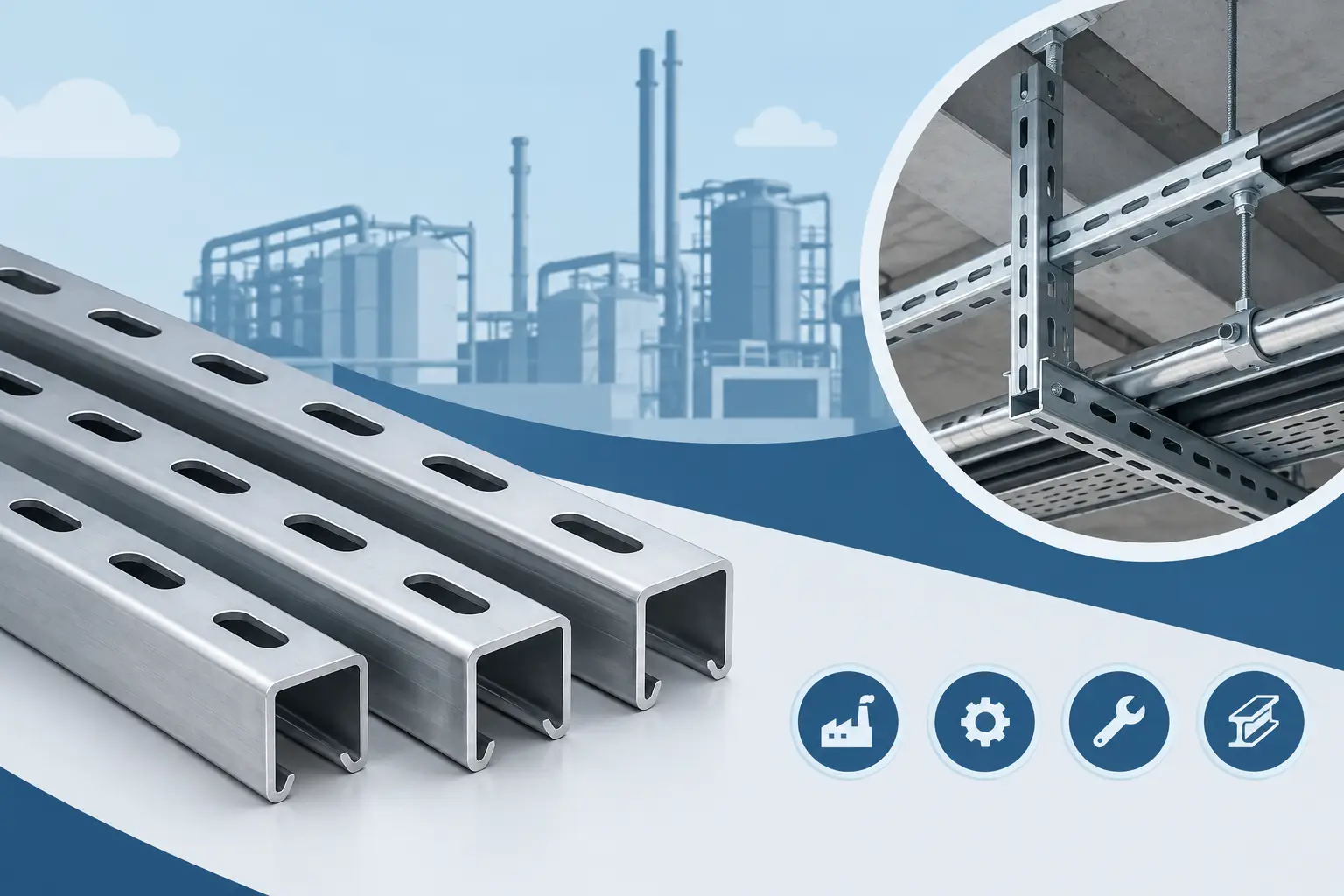
Cable tray runs, pipe supports, HVAC equipment frames, electrical containment, and process-line hardware all rely on one requirement: a support system that stays dimensionally dependable in service. SS strut channel provides a corrosion-resistant framing platform for these applications, but correct specification goes beyond choosing a stainless channel with the right nominal size. Grade, section profile, slot pattern, fitting compatibility, loading, and fabrication accuracy all affect field performance.
For procurement teams and engineers, the objective is not simply to buy channel. It is to source a complete support system that fits the application, installs efficiently, and maintains consistent quality across repeat orders.
What SS Strut Channel Is Designed to Do
SS strut channel is a cold-formed stainless steel channel used to build adjustable support structures without on-site welding. The inward-turned channel lips accept spring nuts, channel nuts, bolts, brackets, clamps, and other compatible hardware. This allows installers to position components along the channel length, adjust alignment, and modify assemblies when equipment layouts change.
The system is widely used where conventional welded steel supports are slower to install or harder to alter. Typical applications include mechanical rooms, food-processing facilities, water treatment plants, pharmaceutical production areas, marine installations, chemical handling environments, and outdoor infrastructure. Its value is especially clear where corrosion exposure and maintenance access make material selection a long-term operating decision.
Stainless channel is not automatically the right answer for every project. For dry, controlled indoor environments, galvanized or pre-galvanized steel may provide an economical solution. SS strut channel becomes the stronger choice when moisture, washdown, salt air, cleaning chemicals, temperature changes, or contamination-control requirements justify the additional material cost.
Select the Stainless Grade for the Actual Environment
The two stainless grades most commonly specified for strut systems are Type 304 and Type 316. Both offer good corrosion resistance and are suitable for many industrial support applications. The correct choice depends on the exposure, not just the product description.
Type 304 stainless steel is commonly used for general industrial, commercial, and indoor applications. It performs well in many humid environments and delivers a clean, durable finish for support installations. Where the channel will be installed indoors and not subjected to chloride-heavy chemicals or coastal exposure, 304 is often the practical balance between corrosion resistance and cost.
Type 316 stainless steel includes molybdenum, which improves resistance to chlorides and more aggressive chemical environments. It is frequently specified for coastal sites, marine hardware, wastewater facilities, food and beverage washdown areas, and applications exposed to de-icing salts or chemical cleaning agents. The higher cost is justified when premature corrosion would create replacement costs, downtime, or safety concerns.
Material grade should also match the connected hardware. A 316 channel paired with lower-grade bolts, nuts, clamps, or brackets can introduce an avoidable weak point. Specify the required stainless grade across the assembly, then confirm whether mixed materials may create galvanic corrosion in the operating environment.
Profile, Gauge, and Slots Affect System Performance
Strut channel is available in several profiles, including shallow, standard-depth, deep, and back-to-back configurations. Larger sections generally provide greater stiffness and support capacity, while shallow sections may suit lighter services or locations with limited clearance. A channel that appears similar in a catalog may perform very differently once span length, bracket spacing, eccentric loading, and installed accessories are considered.
Material thickness is equally significant. Heavier-gauge channel can improve load capacity and resistance to deflection, but it adds weight and cost. The right gauge should be based on engineering requirements, not a visual comparison with an existing section. For suspended systems, consider the weight of the supported service, the weight of fittings and clamps, anticipated additions, and applicable safety factors.
Slotted channel simplifies installation because hardware can be attached at predetermined intervals without drilling. This is useful for field adjustment and repeatable support layouts. Solid channel can be preferable where a continuous section is needed, where slot openings are not acceptable, or where the design calls for custom hole locations produced to a drawing.
When replacing an existing system, verify the channel width, depth, lip geometry, slot dimensions, material thickness, and nut compatibility. Terms such as unistrut-compatible describe a general functional relationship, but dimensions should be confirmed before ordering. A compatible assembly must fit correctly, carry the intended load, and allow hardware to engage as designed.
Load Capacity Requires an Assembly View
Published channel load data is useful, but it should never be read as a universal rating for the installed support. Channel capacity changes with span, support arrangement, load position, orientation, deflection criteria, connection design, and the type of load applied. A uniformly distributed cable load does not act the same way as a concentrated equipment load at midspan.
The supporting structure also matters. Anchors, threaded rods, beam clamps, concrete inserts, brackets, and weld points may govern the capacity of the full installation before the channel itself reaches its limit. This is why experienced buyers evaluate the support assembly rather than selecting channel in isolation.
For critical installations, provide the required loads, span lengths, support locations, operating environment, drawings, and any project standards during the quotation stage. Clear inputs enable the manufacturer to recommend an appropriate section, material thickness, and hardware configuration. They also reduce the risk of last-minute substitutions that complicate installation.
Specify Fittings and Hardware as Part of the System
A strut support system performs as well as its connections. Angle fittings, flat plates, channel nuts, spring nuts, post bases, pipe clamps, beam clamps, and threaded rods should be selected for the same environmental and mechanical requirements as the channel. Consistent hardware sourcing also improves installation speed because fit and finish remain predictable across the project.
Custom fittings are often valuable when a standard angle or plate adds unnecessary field labor. A fabricated bracket with the correct bends, hole patterns, slot locations, and weldments can reduce measurement errors and eliminate site modification. For OEMs and repeat projects, standardizing a custom fitting can support more consistent installation and purchasing.
Metallix Exports supports standard strut system components as well as custom fabricated hardware for buyers who need application-specific dimensions, stainless grades, and repeatable production quality. This approach helps consolidate channel, fittings, brackets, and related structural hardware within a more manageable supply chain.
Manufacturing Details That Procurement Teams Should Verify
Stainless steel channel should be produced with consistent forming, accurate slot placement, clean cut ends, and stable dimensions from batch to batch. These details influence whether channel nuts slide properly, whether fittings align without forcing, and whether long support runs assemble efficiently in the field.
For fabricated or punched channel, dimensional tolerances should be agreed upon before production. Hole diameter, center-to-center spacing, slot orientation, channel length, bend position, and weld location may all be critical depending on the assembly. If the parts interface with third-party hardware or predrilled building components, provide samples or controlled drawings whenever possible.
Surface condition also deserves attention. Mill finish may be suitable for many stainless applications, while brushed, polished, passivated, or other specified finishes may be needed for visible installations, hygiene-sensitive environments, or corrosion-control requirements. Finishing is not merely cosmetic when the application involves washdown, contamination control, or exposure to corrosive residues.
Quality documentation should match the project risk. Buyers may require material test certificates, inspection reports, dimensional verification, weld inspection records, coating or finishing details, packaging specifications, and traceability by lot. Not every order needs the same document package, but defining the requirement early prevents delays near shipment.
Plan Supply Around Installation and Export Needs
Long channel lengths require careful packaging to prevent bending, edge damage, and mixed-material shipments. For export orders, bundles should be identified clearly by part number, grade, length, and quantity, while fittings and hardware should be packed to support receiving and installation. Clear marking can save significant time when a project team is sorting multiple support components on site.
Lead time should account for more than forming and punching. Material availability, tooling, custom fabrication, surface finishing, inspection, packaging, and international freight all influence delivery. For repeat demand, a release schedule or forecast can help stabilize production planning and reduce the pressure of urgent replenishment orders.
The most effective SS strut channel specification is one that translates directly from drawing to finished assembly: the correct grade for the environment, the right profile for the load, compatible hardware for the connection, and documented quality for the project. When those decisions are made before production begins, installation crews receive hardware that fits the work instead of hardware that creates more work.