
 E-mail :
 Call Us :
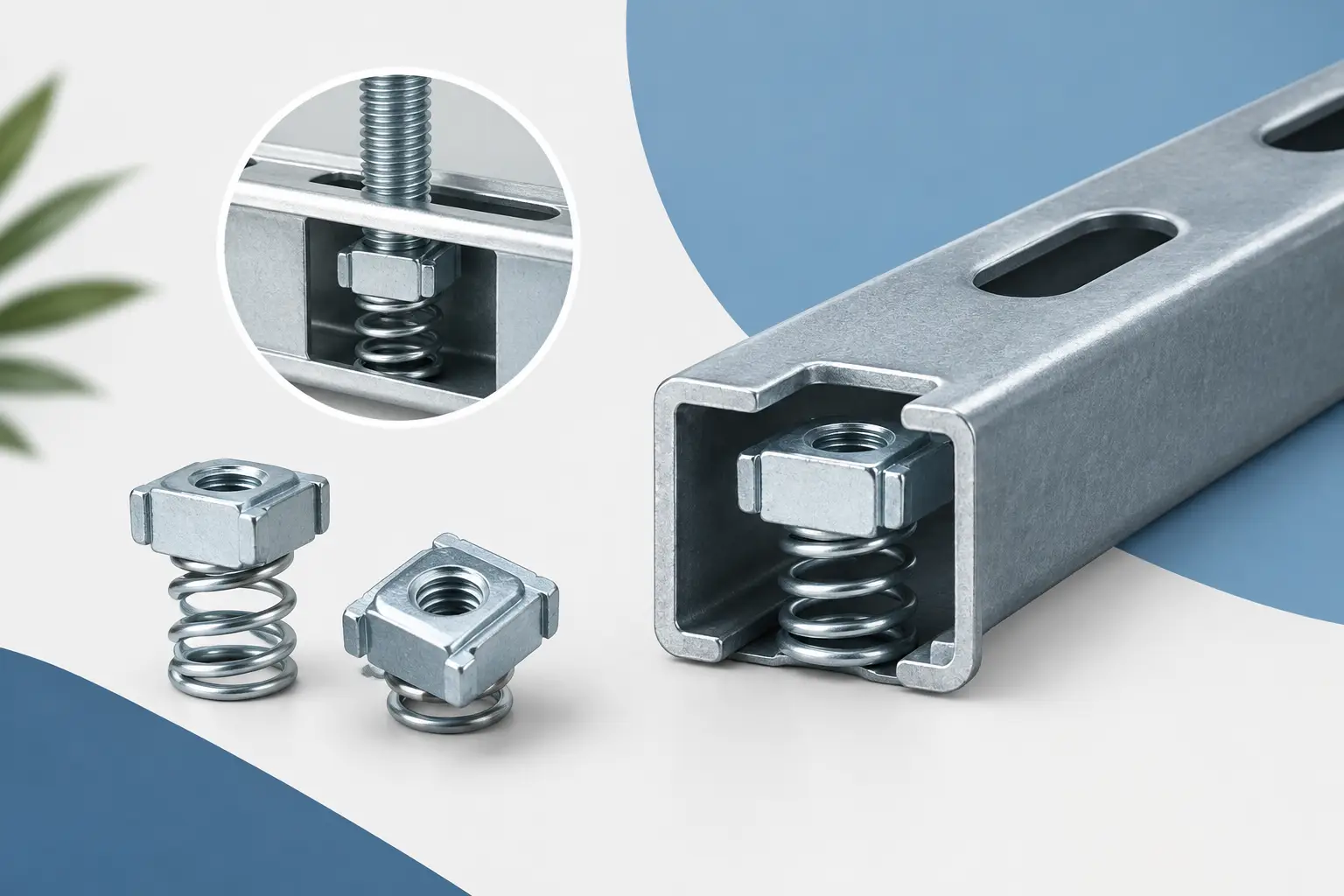
A strut assembly is only as dependable as the connection inside the channel. Spring nuts create that connection by providing a threaded fastening point wherever a bracket, clamp, conduit support, pipe hanger, or fabricated component must be secured to strut channel. For procurement teams and installers, the part may look simple. Its fit, thread quality, spring action, material, and coating can determine whether installation proceeds efficiently or creates avoidable field issues.
For projects that rely on modular support systems, specifying the right spring nut reduces drilling, welding, and rework while preserving the adjustability that makes strut channel valuable. The correct selection starts with the application, not simply the bolt size.
What Spring Nuts Do in a Strut System
A spring nut, also called a channel nut or strut nut, is designed to sit inside a strut channel and accept a threaded bolt. Its spring holds the nut in position during assembly, allowing an installer to align a fitting before tightening the fastener. The teeth or serrations on the nut bite into the channel lips as torque is applied, helping resist movement along the channel.
This design is especially useful where access to the back side of the channel is limited. Instead of using a conventional nut and washer arrangement, the installer inserts the spring nut through the channel opening, rotates it into position, and tightens the bolt through the mounted component.
The result is a flexible fastening point that can be repositioned as support layouts change. That flexibility makes spring nuts common in electrical support, HVAC framing, mechanical installations, equipment mounting, industrial racking, and light structural assemblies.
Selecting Spring Nuts by Channel Compatibility
Channel compatibility should be confirmed before thread size or finish. A nut intended for standard 1-5/8 inch strut channel may not seat correctly in shallow, narrow, or specialty channel profiles. Even nominally similar channel systems can differ in internal dimensions, lip geometry, slot arrangement, and material thickness.
A properly matched spring nut should enter the channel without excessive force, rotate into its working position cleanly, and engage both channel lips when tightened. If the spring is too short or too weak for the profile, the nut can shift during installation. If the body is oversized, it may bind or fail to rotate. Either condition slows field work and can compromise alignment.
For buyers sourcing unistrut-compatible hardware, compatibility should be treated as a dimensional requirement. Request the channel profile, channel depth, width, slot configuration if applicable, and the intended installation orientation. These details help a manufacturer supply a nut that performs consistently with the specified framing system.
Spring Type and Installation Control
The spring is not merely a retention feature. It affects handling speed and installer control. Short springs are often suitable for standard channel work where the nut only needs to remain in place briefly before fastening. Long springs can provide greater positioning support, particularly when multiple nuts must be staged inside a vertical or overhead channel.
The appropriate choice depends on the assembly method. A contractor installing repeated overhead trapeze supports may value a spring that holds firmly during alignment. An OEM producing controlled bench assemblies may prioritize a compact profile and predictable insertion behavior instead. Neither option is universally better - the application determines the right balance.
Thread Size Must Match the Complete Assembly
Spring nuts are available with a range of thread sizes to accommodate common bolts, threaded rods, and support hardware. Typical requirements may include 1/4 inch, 5/16 inch, 3/8 inch, 1/2 inch, or metric threads such as M6, M8, M10, and M12. Selecting the thread is not simply a matter of matching the bolt already on hand.
The thread must suit the required load, the thickness and type of the attached component, the available installation space, and any applicable project specification. Larger threads generally provide greater fastening capacity, but they also require compatible hardware and may not fit every channel or bracket arrangement.
Thread quality matters as much as nominal size. Inconsistent tapping, poor thread form, burrs, or inadequate material strength can lead to cross-threading, difficult tightening, and reduced holding performance. For high-volume installation work, these small defects become expensive quickly. Reliable spring nuts should accept the specified fastener smoothly and maintain consistent engagement from lot to lot.
When a project involves custom brackets or fabricated supports, it is useful to review the complete connection: channel profile, spring nut, bolt or rod, washer arrangement, bracket hole size, and expected load direction. This approach prevents a technically correct individual component from becoming a weak point in the finished assembly.
Material and Coating for the Jobsite Environment
Material selection should reflect exposure conditions, not just initial cost. Carbon steel spring nuts with zinc plating are widely used for indoor commercial and industrial installations where normal moisture exposure is limited. They offer an economical option for many dry, controlled environments.
For outdoor structures, humid facilities, coastal applications, washdown areas, or installations exposed to corrosive agents, a more protective finish or stainless steel construction may be necessary. Galvanized finishes can provide added corrosion resistance for certain construction and infrastructure uses, while stainless steel is often selected where long-term environmental resistance is essential.
There is a trade-off. Higher-corrosion-resistance materials and finishes typically increase component cost, and stainless hardware may require particular attention when paired with dissimilar metals. However, replacing corroded support hardware after installation can cost far more than specifying the correct finish at the start.
Procurement specifications should clearly define the required base material and finish. Terms such as “zinc plated” or “galvanized” can be insufficient without confirming coating type, thickness expectations, and project exposure. Where traceability or compliance documentation is required, it should be identified before production begins.
Load Performance Depends on the Assembly
A spring nut does not carry load in isolation. Performance depends on channel gauge, channel profile, fastener grade, bracket design, tightening torque, direction of force, spacing, and installation quality. A published capacity for one configuration should not be assumed to apply to every assembled condition.
For example, a pipe support imposing a sustained vertical load has different demands than a lateral brace connection or a vibration-prone equipment frame. Dynamic loads, shock, thermal movement, and repeated adjustment can require a more conservative fastening design. If the application is safety-critical or engineered for significant loads, the full strut system should be evaluated against the relevant project standards and engineering requirements.
Installers should also avoid overtightening. Proper torque helps seat the nut teeth into the channel lips and clamp the connected fitting securely. Excessive torque, however, can damage threads, deform lighter-gauge components, or create inconsistent results across the assembly.
Quality Checks That Prevent Field Delays
For B2B buyers, spring nuts are often ordered in large quantities and used across multiple crews, facilities, or production lines. Consistency is therefore as valuable as the part itself. A supplier should be able to control key characteristics including thread accuracy, body dimensions, spring retention, tooth formation, coating coverage, and packaging integrity.
Before approving a production order, verify the sample against the actual channel and bolt used in the field. Check insertion, rotation, spring hold, bolt engagement, tightening behavior, and final seating. This simple trial can expose compatibility problems that dimensional inspection alone may not reveal.
For repeat programs, define the specification in practical terms: channel series, thread designation, spring style, material grade, finish, packaging quantity, labeling requirements, and any inspection or certification needs. Clear specifications reduce variation and make incoming quality checks faster for distributors, OEMs, and contractors.
Custom Spring Nuts for Specialized Hardware Programs
Standard spring nuts meet many installation needs, but custom requirements arise when projects use nonstandard channel profiles, uncommon thread sizes, special coatings, captive hardware, or application-specific geometry. Custom production can also be appropriate when a buyer needs spring nuts packaged with brackets, clamps, fasteners, or complete strut support kits.
Metallix Exports supports standardized and custom metal hardware programs with production capabilities suited to precision forming, punching, threading, finishing, and export-ready packaging. For buyers managing multiple support components, consolidating compatible hardware through one manufacturing partner can simplify specifications, quality control, and shipment planning.
The most useful spring nut specification is one that reflects how the hardware will actually be installed. Confirm the channel, thread, environment, load conditions, and assembly method before releasing a purchase order. That upfront discipline helps ensure each connection is secure, repeatable, and ready for productive installation.