
 E-mail :
 Call Us :
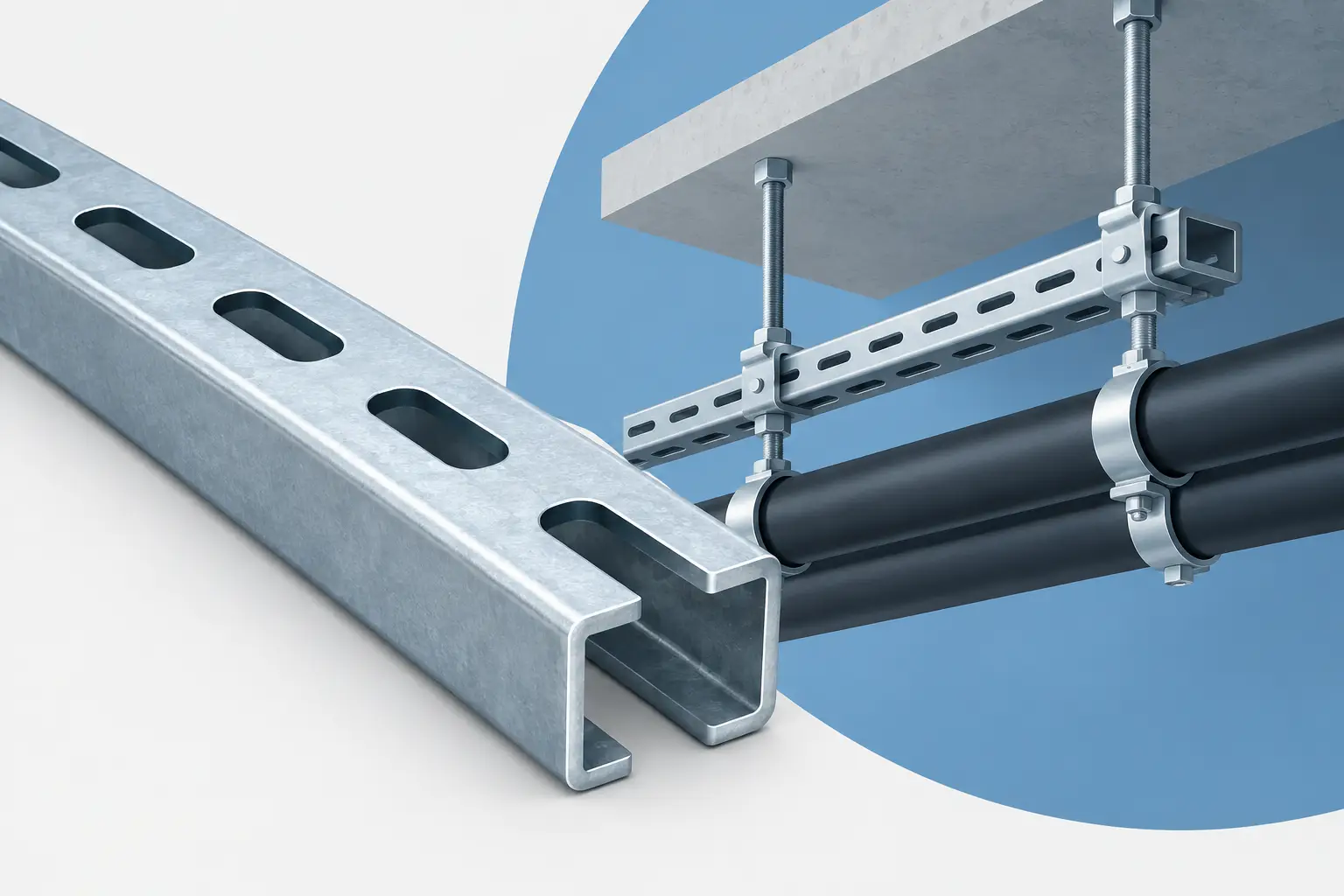
A slotted strut channel can look like a simple piece of formed steel, but its performance depends on details that are often decided before installation begins. Channel profile, material thickness, slot geometry, protective finish, fastener selection, and load path all affect whether a support system remains stable, adjustable, and serviceable over its working life.
For contractors, OEMs, distributors, and procurement teams, the advantage is clear: a properly specified channel system reduces field drilling, supports repeatable assembly, and allows components to be repositioned when site conditions change. The objective is not merely to source channel stock. It is to source a compatible, dimensionally consistent support solution that matches the application.
What Makes a Slotted Strut Channel Different?
Strut channel is a cold-formed metal framing profile, typically manufactured with inward-facing lips that accept channel nuts, spring nuts, bolts, and related fittings. The slots punched along the web create adjustable fastening points without requiring welding or additional drilling at the jobsite.
A solid channel may be appropriate where maximum section continuity is required or where mounting positions are fixed. A slotted profile is generally preferred when installers need flexibility for aligning trapeze supports, pipe clamps, cable tray, conduit, HVAC equipment, solar frames, machinery guards, or secondary structural hardware.
That flexibility has a practical limit. Slots reduce the net cross-sectional area of the channel, which can affect allowable load capacity compared with an equivalent solid profile. The correct choice therefore depends on the span, point loads, bracket arrangement, support spacing, and applicable design requirements. A channel should be selected based on engineering conditions, not only on nominal dimensions.
Key Specification Decisions Before You Buy
Profile Size and Wall Thickness
The channel profile must suit the fittings and loading demands of the system. Common strut configurations include shallow, standard, deep, single, and back-to-back channels. Deeper sections may provide greater stiffness over longer spans, while shallow sections can be effective where clearance and weight are more important than high load capacity.
Wall thickness is equally significant. Thicker-gauge channel generally provides improved resistance to bending and deformation, but it also increases material cost and weight. For high-volume installations, selecting the right thickness can materially affect total project cost. For safety-critical or heavily loaded supports, the lowest-cost gauge is rarely the right decision.
Buyers should confirm actual material thickness, dimensional tolerances, lip geometry, and straightness requirements. These details determine whether channel nuts and compatible accessories fit correctly and whether assemblies can be installed consistently across a project.
Slot Pattern and Compatibility
Slot length, width, spacing, and edge condition should be specified with the intended hardware in mind. A slot pattern that works well for one bolt size or fitting range may not suit another. Standardized spacing can simplify prefabrication and field alignment, especially when a project uses repetitive supports across multiple floors, production lines, or equipment skids.
Compatibility is especially important for buyers using unistrut-compatible systems. The channel, spring nuts, clamps, brackets, post bases, angle fittings, and fastening hardware must work together without forcing field modifications. A nominally compatible product that varies in lip dimensions or slot placement can slow installation and create avoidable sourcing issues.
For custom programs, slotting can be tailored to a drawing, fixture, mounting pattern, or assembly sequence. This is valuable when standard channel lengths create unnecessary cutting waste or when a customer needs a channel that serves as both a structural support and a component within a larger fabricated assembly.
Material Selection
Material selection should reflect the environment, required strength, finish requirements, and fabrication process. Mild steel is widely used for indoor industrial and commercial support systems because it offers strength, formability, and cost efficiency. Galvanized steel is often selected where added corrosion resistance is required, including warehouses, utility areas, outdoor enclosures, and moisture-prone facilities.
Stainless steel is appropriate for more demanding corrosion environments, such as food processing, marine installations, chemical exposure, and certain exterior applications. Aluminum may be preferred where weight reduction or nonmagnetic properties are important, although its strength, stiffness, and galvanic corrosion considerations should be evaluated carefully.
The surrounding hardware matters as much as the channel material. Combining dissimilar metals without considering moisture exposure can create corrosion risks. Specify channel, nuts, bolts, washers, clamps, and brackets as a system rather than as unrelated line items.
Surface Finish and Corrosion Protection
The required finish depends on where and how the channel will be used. Pre-galvanized material can be a practical option for many indoor applications. Hot-dip galvanizing provides heavier zinc protection and is commonly considered for more exposed environments. Powder coating may be selected for appearance, identification, or additional surface protection, while stainless steel can eliminate the need for a separate coating in suitable applications.
There are trade-offs. Heavy coatings can affect threaded connections and accessory fit if dimensions are not controlled. Cut edges, drilled holes, weld areas, and field modifications may also require attention because they can become corrosion initiation points. If the channel will be cut or welded after finishing, identify the required touch-up or post-fabrication treatment in the specification.
Designing the Support System Around Real Loads
Channel selection should begin with the actual support arrangement. A suspended trapeze supporting conduit behaves differently from a wall-mounted bracket carrying a pipe run. A machinery frame may experience vibration, while a rooftop support can be exposed to wind, thermal movement, water, and corrosion.
The load path should be clear from the supported item to the channel, fittings, threaded rod or anchors, and finally to the building structure or foundation. Every connection in that path must be suitable for the anticipated static, dynamic, and environmental conditions. The capacity of the channel alone does not establish the capacity of the assembled support.
Deflection also deserves attention. A member may remain below its ultimate load limit yet deflect enough to misalign equipment, create drainage issues, strain connected services, or affect appearance. Longer spans, concentrated loads, eccentric brackets, and frequent slotting can all influence stiffness. For engineered applications, use documented load data and have the design reviewed by the responsible engineer.
Manufacturing Details That Affect Installation
A reliable strut channel program depends on repeatable manufacturing. Accurate punching keeps slots consistent from one length to the next. Controlled roll forming maintains profile shape and lip dimensions. Clean cutting reduces sharp edges and improves assembly handling. Straightness and twist control matter because distorted channel can complicate long runs and prefabricated frames.
For export and multi-site projects, consistency becomes even more important. Procurement teams need confidence that a replacement shipment will match previously installed fittings and that channel lengths will arrive packaged to protect finished surfaces. Clear labeling, lot traceability, inspection procedures, and export-ready packing help reduce receiving and installation delays.
Metallix Exports supports both standard strut support requirements and custom fabricated channel programs, including punching, bending, welding, finishing, and assembly where the application calls for a more complete solution. This can simplify sourcing when a project requires channels alongside brackets, clamps, hardware, and fabricated support components.
When Custom Slotted Channel Is the Better Choice
Standard lengths and profiles are efficient for common installations, but they do not always provide the best commercial result. Custom channel can reduce field cutting, eliminate secondary drilling, improve fit within confined equipment layouts, and shorten installation time. It can also allow a manufacturer to incorporate application-specific mounting holes, end treatments, welded tabs, gussets, or formed features.
Custom work requires complete input. Provide profile dimensions, material grade, thickness, slot pattern, overall length, tolerance expectations, finish, packaging requirements, annual quantity, and any mating components. If the channel interfaces with an existing system, supplying a sample or detailed drawing helps prevent compatibility assumptions.
For lower-volume specialty projects, a custom solution may carry higher unit costs than stock material. For repeat production, large installations, or assemblies with extensive field labor, it may deliver a lower installed cost. The right evaluation considers material price, fabrication time, jobsite labor, waste, installation risk, and long-term maintainability.
Build Flexibility Into the Specification
The best slotted strut channel specification gives installers enough adjustment without compromising structural requirements or supply consistency. Define the application, expected load conditions, environmental exposure, compatibility needs, and quality requirements before issuing a purchase order. That preparation helps prevent a low-cost channel from becoming an expensive field problem.
When the channel, fittings, finish, and fabrication details are aligned from the start, the finished support system is easier to install, easier to inspect, and better prepared for future changes.