
 E-mail :
 Call Us :
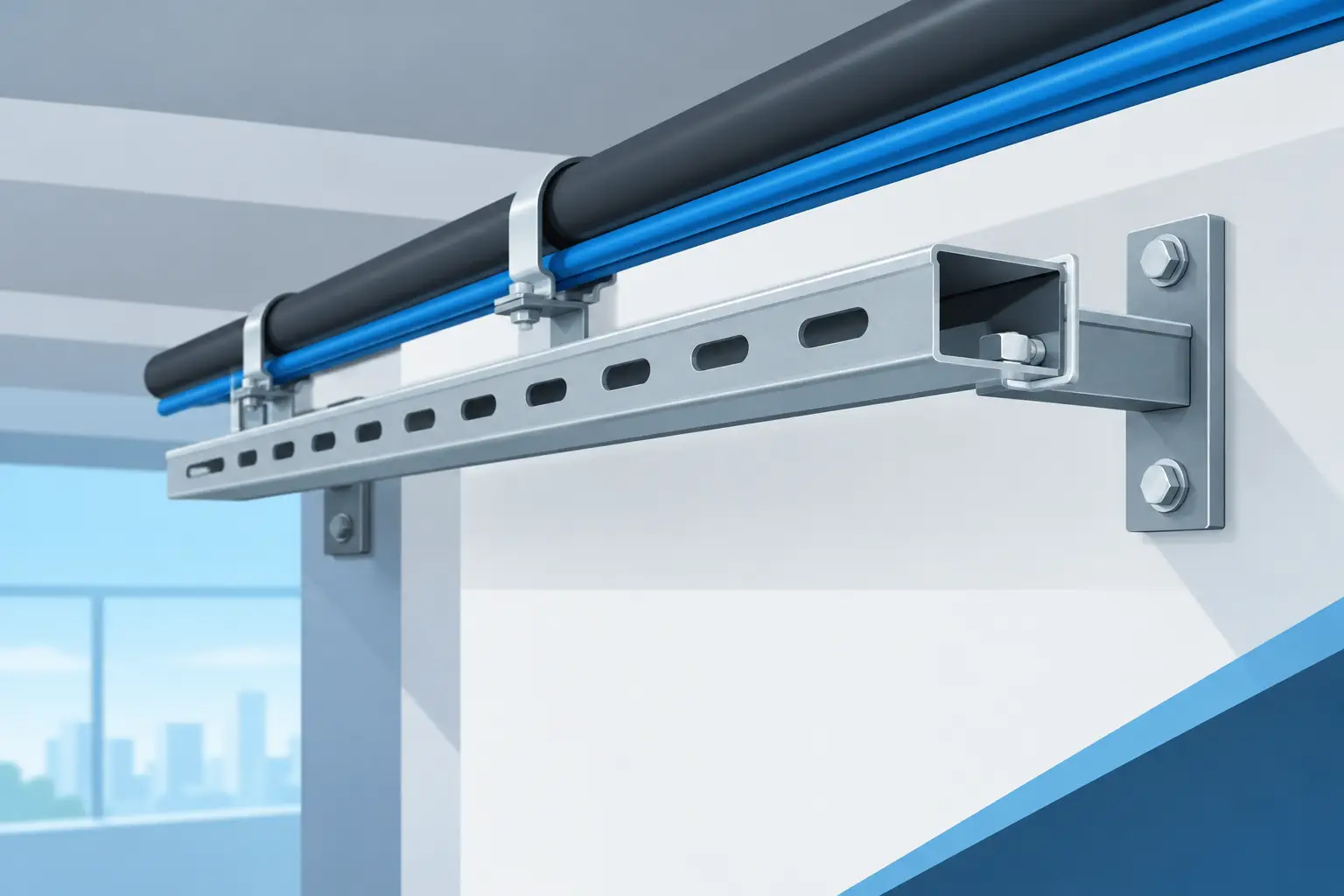
A support route that fits on a drawing can still fail at installation when a standard-depth channel conflicts with ductwork, cable tray, access panels, or finished clearances. Shallow uni strut gives project teams a lower-profile framing option for these constrained areas, but selecting it correctly requires more than choosing the smallest channel available. The channel, fitting, fastener, finish, and load path must work as one support assembly.
What Shallow Uni Strut Is Designed to Solve
Shallow uni strut is a reduced-depth metal strut channel used to build adjustable support frames, racks, trapezes, equipment stands, and utility supports where vertical space is limited. Like standard strut systems, it accepts compatible channel nuts, bolts, brackets, clamps, and fittings, allowing field adjustment without welding at the jobsite.
Its primary advantage is clearance. A shallow profile can keep a support frame closer to the deck, wall, or equipment surface, which is valuable above suspended ceilings, inside electrical rooms, around mechanical services, and within compact OEM assemblies. The lower channel depth can also improve access where a deeper profile would obstruct maintenance or interfere with adjacent components.
That space saving comes with a practical trade-off. Channel depth contributes to stiffness and bending resistance. A shallow section may be appropriate for short spans and controlled loads, yet it may not provide the same capacity as a deeper channel under identical loading conditions. The correct choice depends on span, load direction, attachment method, bracing requirements, and the safety factors established for the project.
Where a Shallow Profile Makes Sense
A shallow channel is commonly specified for overhead service supports where every inch matters. Electrical contractors may use it for light conduit and cable management frameworks. HVAC teams may use it for smaller accessory supports, controls, or short trapeze arrangements. It is also useful in industrial facilities where pipe, controls, and equipment must be supported within crowded retrofit zones.
For OEM and equipment manufacturers, shallow strut can provide an adaptable framework inside enclosures, skids, machinery guards, and modular assemblies. Its compatibility with standard strut hardware helps simplify adjustments during prototype development and production installation.
It is not automatically the right answer for heavily loaded services, long unsupported spans, cantilevered arms, or assemblies exposed to vibration and dynamic loading. In those cases, a deeper channel, a doubled channel arrangement, additional bracing, or an engineered fabricated support may be the better commercial and technical decision.
Design the Entire Support Assembly
The channel is only one part of the system. Reliable support performance depends on how forces move from the supported item through the fitting, channel, connection hardware, and finally into the structure. Reviewing that complete load path early prevents a low-profile design from creating unexpected weakness at a connection point.
Match channel depth to span and loading
Start with the actual supported weight, including the service, insulation, fittings, valves, accessories, and any foreseeable maintenance load. Then account for the span between support points and whether the load is centered, distributed, or offset. An off-center load can introduce torsion that becomes more significant in a shallow channel.
Do not rely on a channel’s appearance to judge capacity. Manufacturers’ published load data, project engineering requirements, and applicable code provisions should guide the final selection. Where the application involves occupied spaces, critical services, seismic requirements, or unusual loading, the assembly should be reviewed by the responsible design professional.
Specify compatible fittings and channel nuts
Shallow channels need fittings sized for their profile and compatible with the channel opening, lip geometry, and material thickness. A bracket that fits physically may still create poor bearing contact, restrict adjustment, or concentrate load at an unsuitable location.
Channel nuts are equally important. Select the proper thread size, spring configuration where needed, and engagement for the channel system. The connection should be accessible for tightening and inspection. In tight overhead conditions, installers also need enough clearance to position the nut, engage the fitting, and apply the specified torque.
Consider deflection, vibration, and bracing
A support can meet a basic static-load requirement and still perform poorly if it deflects too much. Excess movement can affect pipe slope, cable alignment, access clearances, and the perceived quality of an installation. Deflection limits should be established according to the supported system and project specifications.
Vibration changes the evaluation. Mechanical equipment, pumps, fans, conveyors, and mobile applications can loosen connections or fatigue inadequately braced framing. Depending on the application, cross bracing, lock hardware, isolation components, welded reinforcements, or a different channel profile may be required.
Material and Finish Selection Matter
Material selection should reflect the operating environment rather than purchase price alone. Pre-galvanized steel can be suitable for many dry interior applications. Hot-dip galvanized steel is often selected where stronger corrosion protection is needed, particularly in exterior or moisture-prone settings. Stainless steel is a practical option for corrosive environments, food-related operations, marine exposure, and applications requiring a higher level of corrosion resistance.
Aluminum may reduce weight and offer corrosion resistance, but its strength, stiffness, fastening behavior, and compatibility with adjacent metals must be evaluated separately. When dissimilar metals are used, galvanic corrosion can become a concern in wet or corrosive conditions.
Finish requirements should include the channel, fittings, hardware, and any custom components. A corrosion-resistant channel paired with untreated fasteners can shorten the service life of the complete assembly. Procurement teams should request a consistent finish specification across the bill of materials whenever environmental exposure warrants it.
Build a Clear Procurement Specification
Vague descriptions such as “low-profile strut” can create costly variation between quotes and shipments. A useful purchasing specification identifies the channel profile, nominal dimensions, material grade, thickness, slot pattern, length, finish, compatible fitting requirements, and required quantities.
For project-sensitive orders, include the intended application and loading information where available. This helps the supplier identify whether the proposed profile is appropriate and whether related brackets, clamps, nuts, or custom supports should be included. It also reduces fragmented sourcing, where channels, fittings, and hardware arrive from different vendors with inconsistent compatibility.
A complete request should address these distinct requirements:
- Channel profile, depth, width, wall thickness, slot pattern, and cut lengths
- Material and finish, including corrosion exposure conditions
- Required fittings, channel nuts, bolts, clamps, and connection hardware
- Load, span, bracing, and installation constraints
- Packaging, labeling, inspection, and export documentation requirements
For repeat production or distributor supply, dimensional consistency is especially important. Small variation in channel lip geometry, slot placement, or formed thickness can affect fitting engagement and field assembly. Quality control should verify critical dimensions before packing, not after components reach the jobsite.
When Custom Fabrication Is the Better Option
Standard shallow uni strut provides flexibility, but some installations benefit from purpose-built parts. A custom bent bracket, welded frame, gusseted stand, slotted plate, or formed mounting component can reduce assembly time and eliminate unnecessary field modifications. This is often valuable when the same support arrangement is repeated across multiple units or sites.
Metallix Exports supports standard unistrut-compatible components and custom fabricated hardware for buyers who need specified tolerances, material options, protective finishes, and export-ready order fulfillment. Combining standard channel hardware with custom brackets or assemblies can simplify sourcing while keeping the final support system aligned with the installation environment.
The best shallow strut solution is the one that protects clearance without compromising the load path, material suitability, or installation quality. Define the constraints early, specify the complete assembly, and use a channel profile that earns its place in the design.