
 E-mail :
 Call Us :
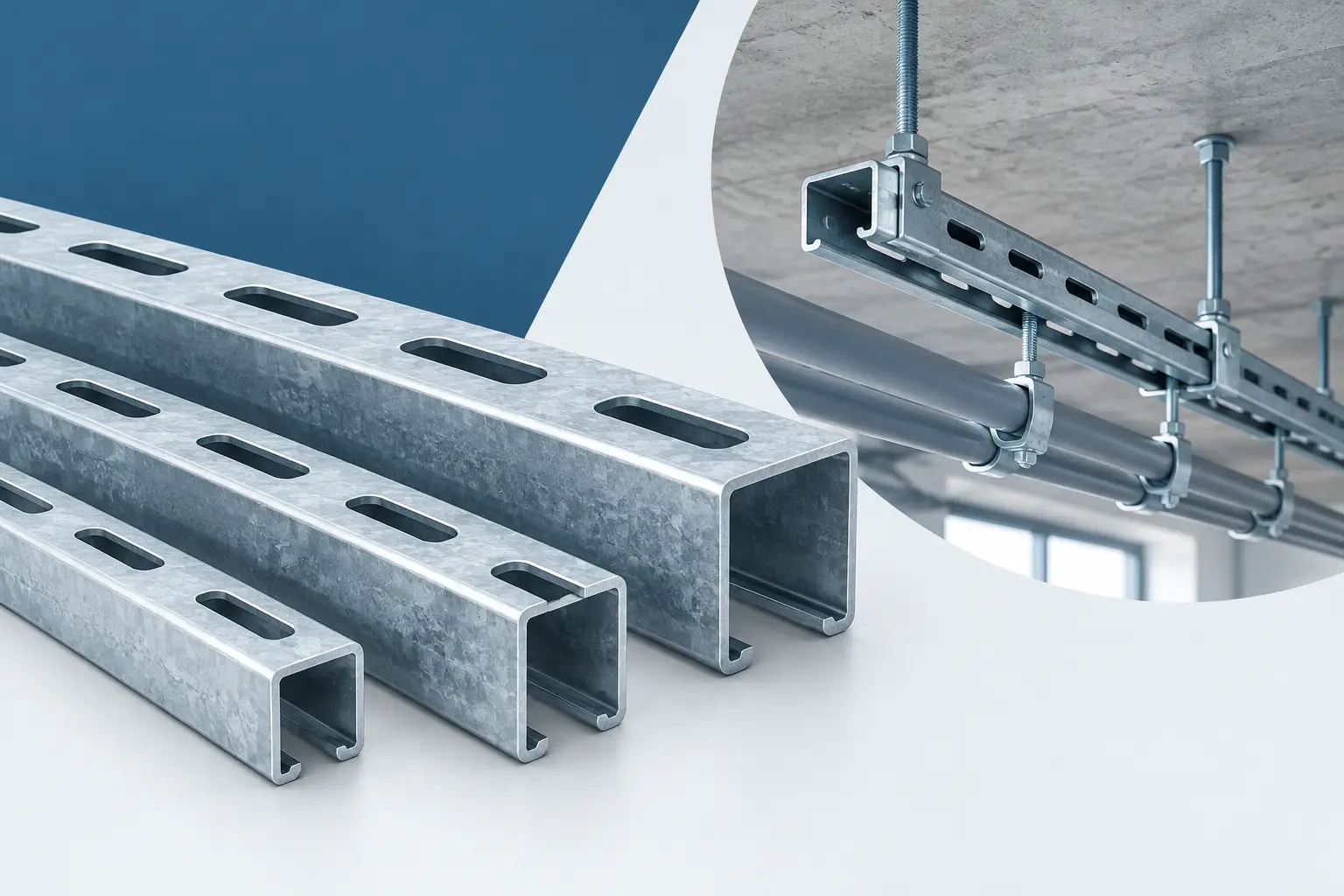
A strut support system is only as dependable as its channel. When cable tray, conduit, pipe supports, HVAC equipment, or machine services must remain aligned over years of use, pre-galvanized strut channels offer a practical combination of corrosion protection, installation flexibility, and cost control. The right channel is not simply a matter of matching a nominal size. It must suit the load, environment, fittings, fasteners, and installation method specified for the project.
For OEMs, contractors, distributors, and procurement teams, the value of pre-galvanized channel lies in predictable performance across repeatable applications. The key is knowing where this finish performs well, where a heavier coating is warranted, and which manufacturing details affect fit and field productivity.
What Pre-Galvanized Strut Channels Are
Pre-galvanized strut channel is roll-formed from steel sheet that has been zinc-coated before forming. The galvanizing process applies a protective zinc layer to the coil, after which the material is slit, punched, and formed into channel profiles. The finished channel typically has an inward-turned lip that accepts compatible channel nuts, spring nuts, brackets, clamps, and other framing hardware.
This production method differs from hot-dip galvanizing after fabrication. With post-fabrication hot-dip galvanizing, the fully formed component is immersed in molten zinc. Pre-galvanized material, by comparison, begins with coated sheet. That makes it an efficient choice for standardized channel systems produced at volume.
The formed channel retains zinc protection across its principal surfaces. However, punching, cutting, and trimming expose steel at edges. Zinc provides sacrificial protection that can help protect nearby exposed steel, but cut edges remain a factor when the channel will face sustained moisture, chemicals, salt exposure, or aggressive outdoor conditions.
Where Pre-Galvanized Strut Channels Fit Best
Pre-galvanized channels are widely specified for interior commercial and industrial installations, including electrical containment, suspended conduit runs, HVAC supports, light-duty pipe supports, equipment framing, and modular service racks. They are also effective in covered locations where humidity is controlled or where short-term exposure during construction is expected.
Their appeal is straightforward: they provide better corrosion resistance than plain or painted mild steel while remaining economical for large quantities of standard support work. The smooth, consistent surface also supports efficient assembly with compatible channel hardware.
Environmental conditions should drive the finish decision. A dry warehouse, data center, manufacturing facility, or interior mechanical room often suits pre-galvanized channel well. A coastal project, wastewater facility, washdown area, chemical-processing site, or permanently exposed exterior installation may require hot-dip galvanized, stainless steel, aluminum, or a project-specific protective system instead.
A lower initial material cost is not a benefit if the finish does not match the service environment. Buyers should evaluate the full installed life of the support system, not only the unit price of the channel.
Selecting the Right Channel Profile and Gauge
Channel dimensions affect both load capacity and compatibility. Common profiles include shallow and deep channels, as well as single and back-to-back configurations. Deep profiles generally provide greater section strength than shallow versions, while back-to-back arrangements can support higher loads or longer spans when properly designed.
Gauge selection matters just as much. A thicker wall can improve load performance and resistance to local deformation around fittings, but it also increases weight and material cost. The proper selection depends on span length, point loads, distributed loads, bracing requirements, connection details, and allowable deflection.
Do not assume that two channels with similar outside dimensions will perform identically. Slot patterns, wall thickness, steel grade, lip geometry, and manufacturing tolerances all influence the finished system. For critical support applications, review manufacturer load data for the specific channel profile and configuration rather than relying on a general catalog category.
Slotted, Solid, or Custom-Punched Channel
Slotted strut channel reduces field drilling and gives installers flexibility when locating rods, brackets, and mounting points. It is often the preferred choice for overhead support systems and adaptable field layouts. The trade-off is that perforations can affect section properties and load capacity compared with equivalent solid channel.
Solid channel is useful where maximum section continuity, clean appearance, or project-specific hole placement is required. It can be drilled or punched to suit the assembly, although field modifications should be controlled to avoid unnecessary coating damage and inconsistent hole locations.
For repeated assemblies or OEM programs, custom punching can improve production efficiency and installation accuracy. Hole diameter, spacing, slot orientation, and end distances should be defined early so the channel can be manufactured to the actual mounting pattern rather than modified at the jobsite.
Compatibility Is a System Requirement
Strut framing performs best when the channel and accessories are treated as one engineered system. Channel nuts must engage the lip correctly. Fittings must match the channel width and depth. Threaded rods, clamps, brackets, and bolts must have suitable strength and corrosion resistance for the intended environment.
Compatibility is especially important when sourcing unistrut-compatible components. Nominally similar channels may have differences in internal width, lip dimensions, slot geometry, or material thickness. Those small differences can affect nut engagement, fitting alignment, and assembly speed.
Before placing a production order, buyers should confirm channel dimensions, accessory fit, finish requirements, and any interchangeability requirements with existing installed systems. A physical sample assembly is often worthwhile for large programs, distributor stock orders, or applications with custom hardware.
Mixed finishes also deserve attention. Using a pre-galvanized channel with plain steel hardware can introduce a weak point in the system. For indoor dry applications, this may be acceptable if specified. In humid or corrosive settings, fittings and fasteners should be selected with equivalent or suitable protection to avoid premature corrosion at connections.
Manufacturing Details That Affect Field Results
Strut channel appears simple, but consistent fabrication requires control at every stage. Coil quality, coating integrity, roll-forming accuracy, punching precision, burr management, straightness, and cut length all influence installation performance.
Poorly controlled punching can leave sharp burrs that interfere with hardware, damage hands during installation, or create uneven bearing surfaces. Inconsistent roll forming can alter the lip profile and make channel nuts difficult to install or rotate into position. Inaccurate cut lengths can create alignment issues across modular frames and support runs.
Quality-focused manufacturing should verify profile dimensions, slot location, length tolerance, surface condition, and packing requirements. For export programs, secure bundling and clear product identification are equally practical considerations. Channel that arrives damaged, mixed, or difficult to identify can delay installation even when the material itself meets specification.
Metallix Exports supports buyers who require both standard strut support components and custom fabricated hardware, helping reduce the complexity of coordinating channels, brackets, clamps, and related metal parts across multiple vendors.
What to Include in a Purchase Specification
A clear purchase specification prevents avoidable substitutions and reduces clarification cycles between purchasing, engineering, and production. For a channel order, identify the profile dimensions, wall thickness or gauge, material grade where required, pre-galvanized finish requirement, slot pattern, cut length, quantity, and packaging expectations.
If the channel must work with an existing support system, state the compatibility requirement directly. If load performance is critical, provide the design load, span, support arrangement, and applicable project standards. For custom parts, include approved drawings with tolerances, hole details, weld requirements, and finish callouts.
It is also useful to establish inspection expectations before production. First-article approval, dimensional reports, sample assemblies, labeling standards, and shipment release requirements can all be appropriate depending on program size and project risk. These controls are particularly valuable for international procurement, where replacing a nonconforming shipment can affect construction schedules.
A Practical Finish Decision
Pre-galvanized channel is a strong choice when the application calls for economical zinc protection, repeatable dimensions, and efficient installation in non-aggressive environments. It is not automatically the correct finish for every building exterior or industrial plant.
Ask three questions before finalizing the specification: What will the channel support? What will it be exposed to? And what accessories must it connect with? The answers will guide the profile, gauge, coating, and fabrication requirements more reliably than a generic product description.
Well-specified strut channel keeps support work moving quietly in the background - exactly where dependable infrastructure belongs.