
 E-mail :
 Call Us :
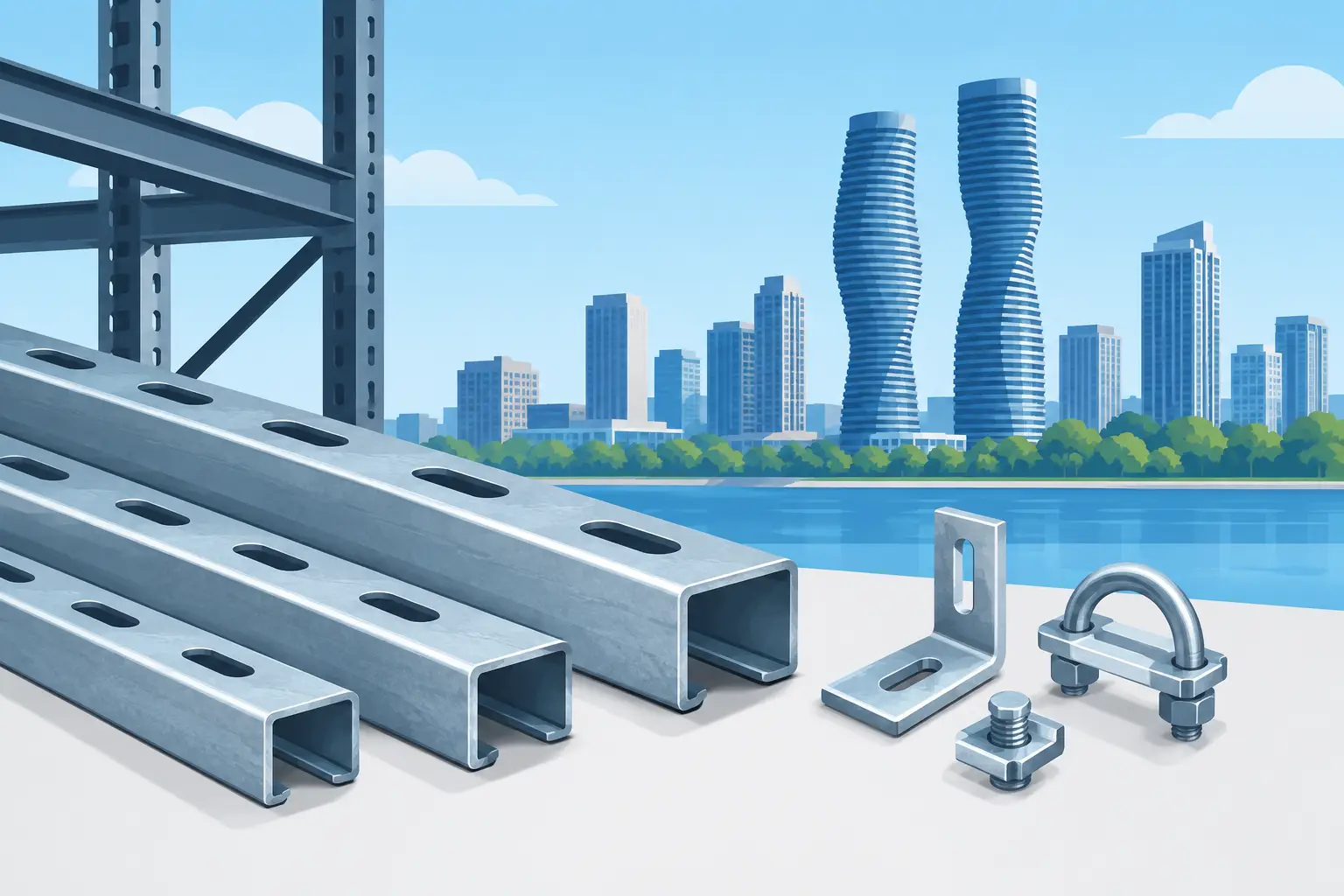
A search for a missisauga uni strut supplier is rarely just about locating channel in stock. For electrical, HVAC, industrial, and construction buyers, the real requirement is a dependable source of compatible components, accurate dimensions, consistent finishes, and supply capacity that supports the installation schedule. A low unit price loses value quickly when channels, fittings, and fasteners do not fit together correctly on site.
Uni strut-compatible framing systems provide a flexible method for supporting cable tray, conduit, piping, equipment, HVAC assemblies, and secondary structural elements. Their usefulness depends on the complete system: channel profile, gauge, hole pattern, spring nuts, brackets, clamps, anchors, and finish must be specified as a working assembly rather than purchased as unrelated parts.
What a Mississauga Uni Strut Supplier Should Deliver
The first question is not simply whether a supplier carries strut channel. It is whether that supplier can provide the right channel configuration for the load, environment, connection method, and installation constraints. Common requirements include solid or slotted channel, single or back-to-back profiles, different material thicknesses, and lengths that reduce field cutting and scrap.
Compatibility matters at every connection point. A channel that appears similar can create delays if its internal dimensions do not accept the specified spring nut or if slot geometry limits adjustment. For buyers replacing an existing system, dimensional consistency is especially important. Procurement teams should confirm channel width, depth, wall thickness, slot spacing, and mating hardware requirements before approving a substitute.
A capable supplier should also understand that standard products are only part of the order. Projects often require angle fittings, flat plates, U-brackets, beam clamps, pipe clamps, post bases, trapeze support hardware, and fabricated assemblies. Sourcing these through one manufacturing partner can reduce vendor coordination and help maintain consistency across the support package.
Start With the Application, Not the Catalog
A catalog is useful for narrowing options, but the application should drive final selection. Indoor electrical support in a controlled commercial building has very different requirements from rooftop mechanical supports, food-processing environments, outdoor infrastructure, or coastal installations.
For standard indoor service, pre-galvanized or powder-coated steel may be appropriate depending on the design and exposure. Outdoor and damp applications commonly call for hot-dip galvanized steel. Stainless steel is often selected where corrosion resistance, sanitation, or chemical exposure is a concern, while aluminum may be preferred where lower weight and corrosion resistance are priorities. Each choice has cost, fabrication, and load-performance implications.
Material selection should be reviewed alongside the required finish. A protective coating is not a generic feature. Its suitability depends on coating coverage, edge condition, expected abrasion, exposure to moisture or chemicals, and whether field cuts will need treatment. Specifying the environment early avoids a common purchasing problem: hardware that meets dimensional requirements but does not provide the intended service life.
Load Capacity Requires More Than Channel Size
Strut channel supports are often treated as simple commodity hardware, yet loading conditions can be complex. Span length, bracket spacing, point loads, cantilevered loads, seismic considerations, connection strength, deflection limits, and anchor capacity all affect system performance.
A thicker channel is not automatically the correct answer. The selected profile must work with the overall support design and the approved installation method. Engineers and contractors should verify load tables, connection details, and applicable project requirements for the complete assembly. Where a nonstandard bracket or welded fabrication is needed, the design should account for the actual load path rather than relying on assumptions based on a standard fitting.
Why Custom Fabrication Can Improve Installation Efficiency
Standard strut hardware is valuable because it enables adjustment in the field. However, too much field fabrication can increase labor, introduce dimensional variation, and extend installation time. Custom-made components can solve this problem when a project has repeated support layouts, unusual mounting surfaces, constrained clearances, or special equipment interfaces.
A manufacturing partner with cutting, punching, bending, welding, and finishing capabilities can produce brackets and support members to drawing specifications. This may include pre-punched hole patterns, formed angles, welded frames, gusseted supports, or assemblies prepared for rapid installation. For OEM buyers, custom parts can be integrated into equipment packages while maintaining compatibility with common strut channel systems.
The trade-off is straightforward. Custom fabrication requires clear drawings, defined tolerances, and production lead time. It is most effective when quantities justify repeatability or when avoiding site labor and rework has significant value. For a one-off installation with changing field conditions, standard adjustable fittings may remain the better choice.
Questions Procurement Teams Should Ask Before Ordering
A reliable procurement process begins with details that affect both technical fit and commercial performance. Buyers should confirm whether the supplier can provide material certifications, dimensional inspection, finish specifications, and packaging suitable for the jobsite or distribution channel.
They should also ask how orders are managed when standard and custom parts are combined. A supplier that can coordinate channel, fittings, clamps, brackets, fasteners, and fabricated supports under one purchase order can reduce receiving complexity and prevent mismatched components. This is particularly useful for multi-location projects and OEM programs that need repeatable bill-of-material control.
Delivery planning deserves the same attention as product selection. Long channel lengths require appropriate handling and packaging to prevent bending or coating damage during shipment. Short-cut lengths may improve freight efficiency and jobsite handling, but they can increase processing requirements. The best option depends on site access, installation sequence, storage space, and project schedule.
Quality Control That Supports Repeat Orders
For distributors, contractors, and OEM sourcing teams, consistency from one shipment to the next is essential. A supplier should have defined controls for incoming material, fabrication dimensions, hole locations, weld quality, surface finish, and final packing. These controls are particularly important when products must work with existing installations or be supplied as part of a pre-engineered assembly.
Tolerance discipline affects installation speed. A bracket with hole centers that vary from the drawing may still look acceptable during inspection, yet it can create alignment issues across a large installation. The same is true of burrs around punched holes, inconsistent bends, or poor coating coverage on fabricated edges. Quality is not only about appearance. It is about predictable assembly in the field.
For export and cross-border supply, documentation and packing requirements should be discussed early. Clear part identification, consolidated packing lists, protective packaging, and shipment coordination help procurement teams maintain control from factory release through final receipt. These practical details are often what separate a usable supply relationship from a recurring source of project delays.
A Manufacturing Partner for Standard and Specialized Hardware
The strongest supplier relationships combine product availability with the ability to respond when a standard component is not enough. Metallix Exports supports industrial and construction buyers with unistrut-compatible channels, brackets, clamps, structural hardware, and custom sheet metal fabrication built around application requirements. Its manufacturing capabilities support precise punching, bending, welding, forming, assembly, and surface finishing across a range of materials.
For buyers serving Mississauga, the GTA, or broader North American and international markets, the value lies in reducing the gap between engineering intent and delivered hardware. A supplier that understands drawings, tolerances, finish requirements, packaging, and shipment timing can help keep a support system moving from specification to installation without unnecessary handoffs.
Before releasing the next strut package, review the complete assembly rather than the channel alone. The right supplier will help ensure that every fitting, fastener, finish, and fabricated support contributes to a system that installs cleanly and performs as intended.