
 E-mail :
 Call Us :
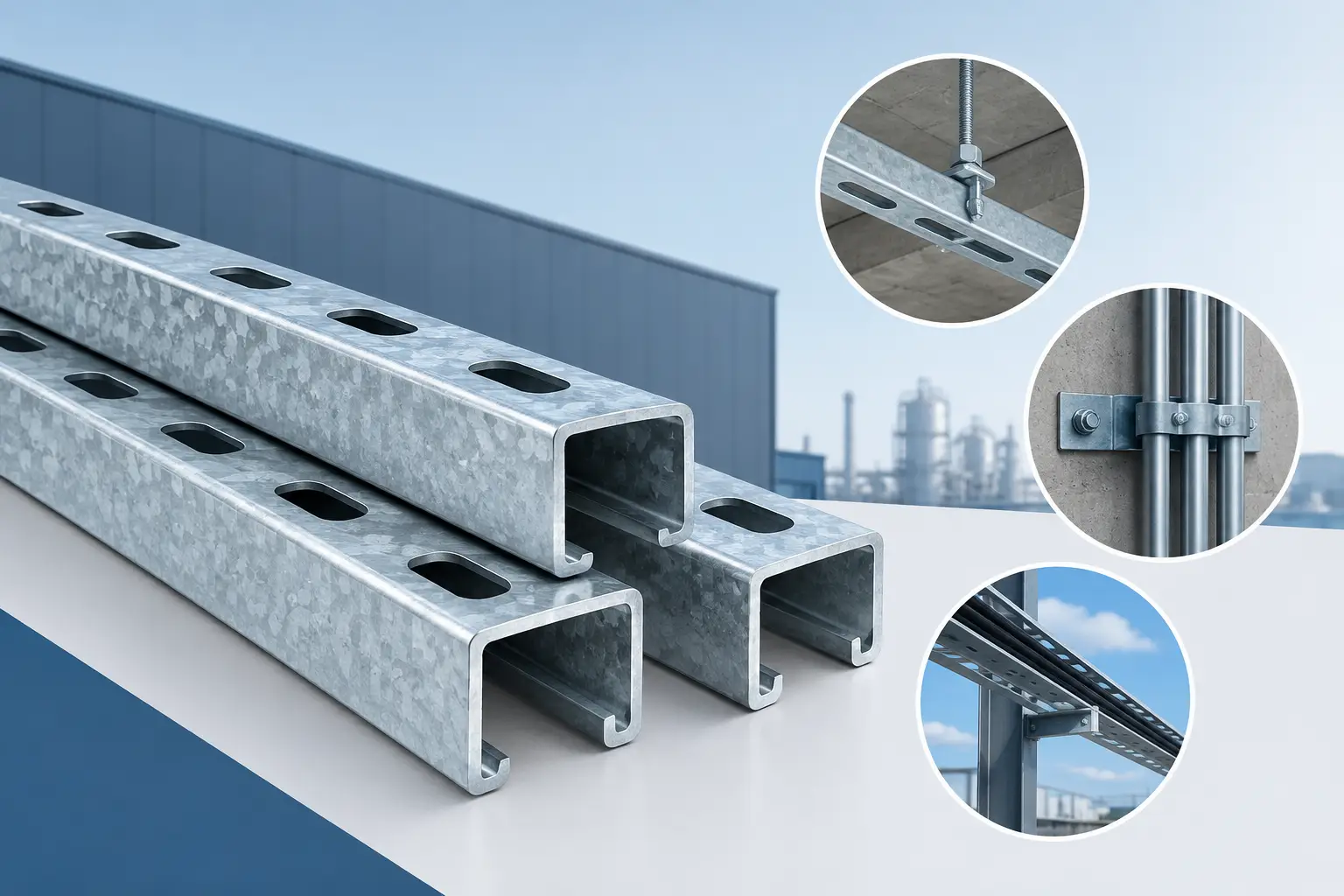
A strut run can look perfectly serviceable on installation day and become the weak point of an outdoor support system years earlier than expected. For electrical, HVAC, process piping, solar, marine-adjacent, and industrial projects exposed to moisture, hot-dip galvanized strut channels provide a practical corrosion-control option that protects the channel inside and out.
The finish alone, however, does not determine whether a support system will perform as intended. Channel profile, steel thickness, slot pattern, loading, fittings, fasteners, fabrication details, and the actual exposure category all affect service life. For buyers and engineers, the right question is not simply whether a channel is galvanized. It is whether the complete strut assembly is specified for the conditions it will face.
What Hot-Dip Galvanizing Changes
Hot-dip galvanizing applies a zinc coating by immersing fabricated steel in molten zinc. Unlike a thin zinc-rich coating applied to sheet before forming, the process creates a metallurgically bonded coating that follows the external surfaces, edges, weld areas, and accessible internal surfaces of the fabricated channel.
That distinction matters on strut channels. Cut edges, punched slots, corners, and field-handled surfaces are common starting points for corrosion when the coating is too light for the environment. A properly hot-dip galvanized channel carries a thicker, more durable zinc layer that acts as both a barrier and sacrificial protection. If the surface is scratched, surrounding zinc can help protect small areas of exposed steel.
The characteristic finish is typically matte gray with visible variation in texture or appearance. This is normal. Buyers should evaluate coating continuity, adhesion, thickness, drainage, and fit with the intended assembly rather than expecting the uniform cosmetic appearance associated with electro-galvanized hardware.
Where Hot-Dip Galvanized Strut Channels Make Sense
Hot-dip galvanized strut channels are commonly selected where ordinary painted steel or pre-galvanized channel may not provide sufficient long-term protection. Typical applications include rooftop equipment supports, exterior conduit racks, parking structures, water and wastewater facilities, agricultural buildings, utility installations, industrial plants, and exposed mechanical systems.
They are especially useful where condensation, rain, washdown, wet-dry cycling, or occasional chemical exposure is expected. In these settings, the cost of replacing corroded support members often exceeds the initial premium for a more durable finish. The value is not only in longer channel life. It also reduces disruption around cable trays, pipe supports, ductwork, and installed equipment.
That said, hot-dip galvanizing is not a universal answer. Highly chlorinated sites, coastal salt exposure, chemical processing areas, and locations with persistent acidic or alkaline contamination may require a more detailed corrosion review. Stainless steel, aluminum, duplex coating systems, or a carefully isolated mixed-material design can be more appropriate depending on the exposure, required life, and maintenance plan.
The environment should drive the finish decision
Indoor dry service and protected warehouse installations may be well served by other finishes. Specifying hot-dip galvanizing in every indoor application can add cost, weight variation, and procurement complexity without creating proportional value.
Conversely, specifying a light zinc coating for a humid outdoor or washdown area is often a short-term saving with a predictable maintenance cost. The finish should be selected against actual site conditions, not a generic indoor-versus-outdoor label. Ask whether the assembly will trap moisture, receive road salt, sit near cooling towers, encounter fertilizers, or remain wet for extended periods. Those details change the specification.
Specify the Channel Before the Coating
A galvanized finish cannot compensate for an undersized channel. Start with the structural requirements: channel depth and width, material grade, wall thickness, span, support spacing, point loads, load direction, deflection limits, and the connection method. Slotted and solid channel options each serve different installation needs.
Slotted channel improves adjustment and allows faster field assembly with channel nuts and compatible fittings. It also reduces net section, which must be accounted for when loads are significant. Solid channel can be preferable where maximum section capacity, fewer openings, or reduced debris accumulation is needed. The correct choice depends on the support layout and installation sequence.
Channel dimensions must also match the fittings and accessories used across the system. A channel may be described as unistrut-compatible, but practical compatibility should be verified through profile dimensions, slot spacing, lip geometry, channel nut engagement, and load requirements. A system that assembles easily in a sample fit-up may still create problems if tolerances vary across production lots.
For procurement teams, a complete purchase description should identify the channel profile, gauge or thickness, length, slot pattern, steel specification, galvanizing requirement, required standards, packaging, and acceptable dimensional tolerances. If channels will be cut, welded, or drilled after delivery, that should be addressed before the finish is selected. Post-galvanizing fabrication can expose steel unless the altered area is repaired using an approved zinc-rich method.
Treat the Assembly as One Corrosion System
Channels are only one part of a strut support system. Spring nuts, channel nuts, bolts, washers, brackets, beam clamps, pipe clamps, post bases, and cantilever arms should be evaluated as a group. A hot-dip galvanized channel paired with lightly coated fasteners can shift the corrosion risk to the fastener connection.
For most outdoor galvanized assemblies, compatible galvanized fittings and fasteners are a logical starting point. Stainless fasteners may be required in certain environments, but mixing materials calls for care. Dissimilar metals, standing water, and conductive contaminants can accelerate galvanic corrosion. The right combination depends on the materials, atmosphere, drainage, and electrical isolation available in the design.
Fit is another practical consideration. Hot-dip galvanizing adds coating thickness, and that can affect threaded engagement, channel nut movement, nesting components, and tight-tolerance fabricated parts. Experienced manufacturers account for coating buildup in thread allowances, hole sizes, bends, and mating interfaces. This is particularly relevant for custom brackets or welded support frames designed around standard strut channels.
Drainage and detailing affect real-world life
The best coating cannot prevent corrosion where water is repeatedly trapped against the steel. Design channel runs and brackets to shed water where possible. Avoid sealed pockets in custom fabrications, orient open channel faces thoughtfully, and provide drainage and venting where required for fabricated assemblies.
For hot-dip galvanizing itself, vent and drain provisions are a safety and quality requirement on hollow or enclosed fabrications. They also help the zinc coat internal surfaces properly. If a project includes welded frames, post bases, or made-to-order brackets, galvanizing should be considered during design rather than treated as the final production step.
Quality Checks That Matter to Buyers
A reliable supply program begins with repeatable material control and dimensional consistency. Channel lengths should be cut square and deburred where required. Slot dimensions and spacing need to support field assembly. Straightness, twist, and profile geometry affect both installation speed and the ability to make long, aligned support runs.
For galvanized products, inspect for bare areas, heavy runs that interfere with fit, sharp zinc spikes, excess ash, blocked slots, and coating damage caused during handling. Cosmetic variation alone is not necessarily a defect, but parts must remain safe to handle and functional with the planned hardware.
Documentation requirements should be defined in the purchase order when they are needed. Depending on the project, buyers may require material certificates, coating verification, dimensional inspection records, lot traceability, first-article approval, or packaging instructions for export shipment. Establishing these expectations before production reduces disputes and prevents a late-stage inspection issue from affecting the project schedule.
Choosing a Manufacturing Partner for Strut Systems
Standard channels are often only the starting point. Projects may require channel cut to exact lengths, custom slot layouts, welded assemblies, special brackets, stamped connection plates, or packaged kits that reduce field sorting. Consolidating those parts with one capable manufacturer can simplify purchasing and improve consistency across the system.
Look for a supplier that can control cutting, punching, forming, welding, finishing, inspection, and export packaging around the same approved drawings. The supplier should also be able to communicate clearly about galvanizing allowances, profile compatibility, capacity assumptions, and lead times. These details are where technically correct designs either become dependable delivered products or create site delays.
Metallix Exports supports standardized and custom strut system requirements with precision sheet metal fabrication, structural hardware production, and export-ready fulfillment. For OEMs, contractors, distributors, and project buyers, that combination helps reduce the number of vendors involved in a finished support assembly.
Before releasing an order, review the installation environment, design loads, channel profile, hardware compatibility, fabrication sequence, and inspection requirements together. A well-specified galvanized strut system is easier to source, faster to install, and far less likely to demand attention after the rest of the project is already in service.