
 E-mail :
 Call Us :
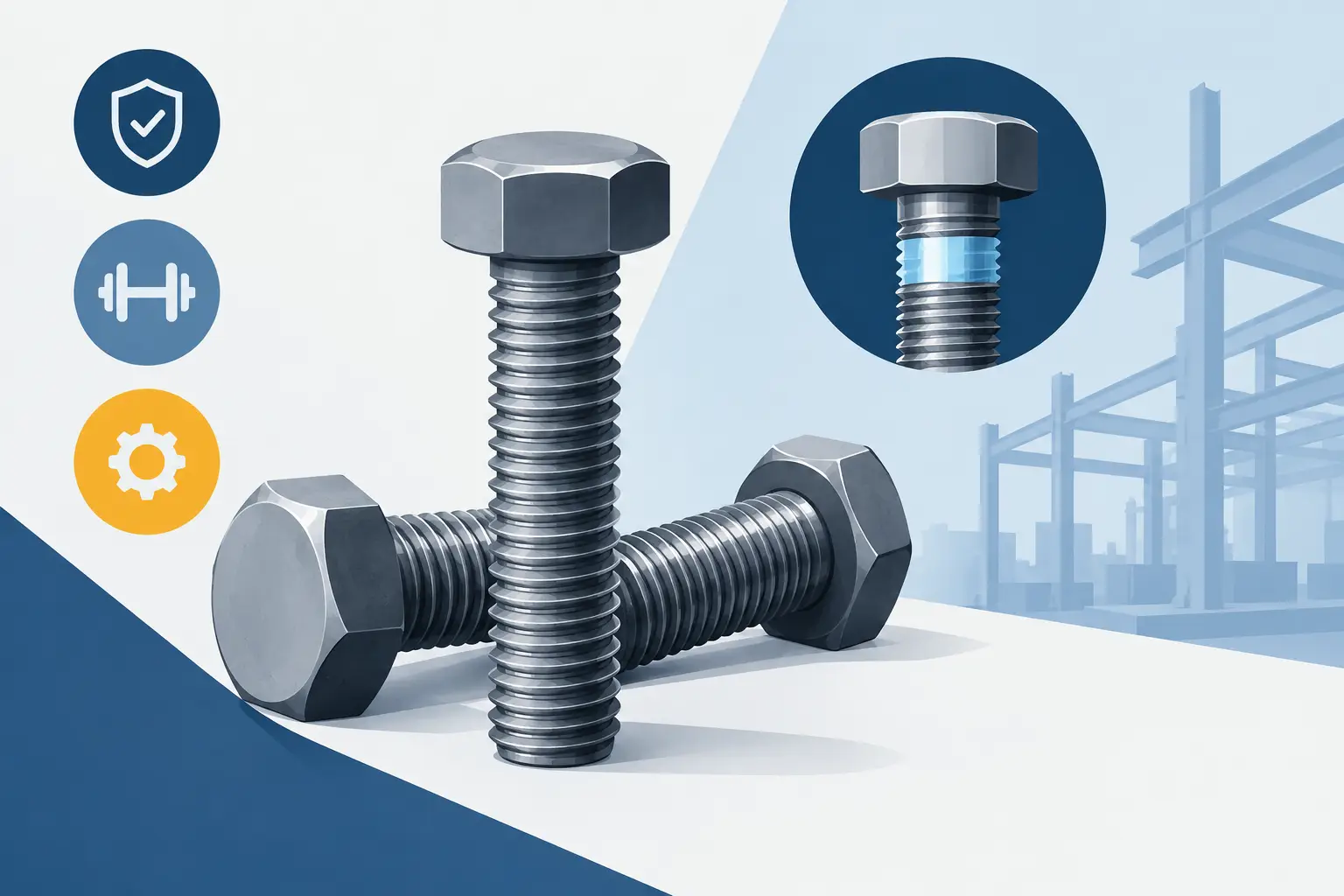
Grade 8 bolts are specified when a joint must carry high clamp loads, resist vibration, and perform reliably under demanding mechanical service. For OEMs, contractors, and procurement teams, the right decision is not simply choosing the highest-strength fastener available. It is matching bolt grade, thread fit, coating, joint materials, and installation method to the actual load path.
A high-strength bolt can support a well-designed assembly, but it can also introduce avoidable risk when paired with the wrong nut, washer, coating, or torque value. The most dependable fastener programs begin with a clear specification and a supplier that can maintain consistency across production lots.
What Grade 8 Bolts Mean
In the United States, Grade 8 typically refers to SAE J429 Grade 8 inch-series bolts. These bolts are made from alloy steel and heat treated to achieve high tensile strength and hardness. They are commonly identified by six radial lines on the bolt head, along with a manufacturer identification mark.
Grade 8 hardware is used where higher clamping force and resistance to tensile loading are required than lower-grade fasteners can provide. Typical applications include heavy equipment, automotive assemblies, industrial machinery, structural brackets, agricultural equipment, trailers, and high-load support systems.
The grade designation matters because it communicates a defined mechanical-performance range. A bolt that looks similar in diameter and thread pitch may not offer the same tensile strength, proof load, hardness, or fatigue performance. For critical assemblies, visual similarity is never a substitute for verified specifications.
Grade 8 Is Not the Same as Class 8.8
One frequent sourcing error is treating SAE Grade 8 and metric property class 8.8 as interchangeable. They are not. SAE Grade 8 is generally stronger than metric class 8.8, and the systems use different thread standards, dimensions, head markings, and mechanical requirements.
Metric fasteners are designated by property classes such as 8.8, 10.9, and 12.9. An SAE Grade 8 bolt requires a compatible inch-series nut and thread form, while a metric bolt requires its matching metric hardware. Procurement documents should state the required standard, diameter, thread pitch, length, finish, and matching nut or washer requirements rather than relying on a general description such as “high-strength bolts.”
When Grade 8 Bolts Are the Right Choice
Grade 8 bolts are appropriate when the joint needs high preload and the connected parts are designed to handle it. Preload is the tension created in the bolt during tightening. That tension generates clamping force, which helps the joint resist movement, separation, and vibration.
For example, a machinery bracket subject to repeated loading may benefit from Grade 8 hardware because adequate clamp force reduces slip between mating parts. The same principle applies to vehicle assemblies, fabricated frames, equipment mounts, and heavy-duty brackets.
However, stronger is not automatically better. If the joined material is thin sheet metal, aluminum, plastic, or a soft casting, a Grade 8 bolt can crush, deform, or pull through the component before the bolt reaches its intended preload. In those cases, the joint may need a larger bearing surface, reinforcement plate, sleeve, formed feature, or a different fastening approach.
A reliable specification considers the complete assembly:
- Applied tensile, shear, vibration, and cyclic loads
- Thickness and strength of the connected materials
- Thread engagement and whether threads are in a nut or tapped hole
- Required corrosion protection and operating environment
- Assembly access, installation equipment, and torque control
The bolt is only one part of the joint. Its performance depends on every component around it.
Selecting Diameter, Thread, and Length
Bolt diameter should be selected from calculated loading and joint geometry, not from availability alone. A larger diameter generally provides more tensile area and shear capacity, but it also requires more space, larger holes, and increased torque. It may be impractical in compact equipment or formed-sheet assemblies.
Thread selection also affects performance. Coarse threads are often preferred for general industrial use because they assemble quickly, are less sensitive to damage, and provide useful engagement in many materials. Fine threads offer a larger tensile stress area for a given diameter and can provide improved adjustment and resistance to loosening in some applications. They also require more careful handling and sufficient thread engagement.
Length must allow the bolt to fully engage the nut while avoiding excessive thread runout within the load-bearing plane. In a bolted joint loaded in shear, it is often preferable for the unthreaded shank to pass through the shear plane where practical. This reduces localized thread stress, although joint design and available standard lengths will determine whether that is achievable.
For through-bolted assemblies, specify enough length for the connected material stack, washers, nut height, and the required thread projection. For tapped holes, confirm engagement depth based on the parent material. A strong bolt installed into inadequate threads will not create a strong joint.
Nuts and Washers Must Match the Bolt
A Grade 8 bolt should be paired with a compatible high-strength nut. Using a lower-grade nut can lead to stripped threads or nut failure before the bolt develops the required clamp load. Specifications should identify the nut grade or governing fastener standard, particularly on safety-sensitive or high-load assemblies.
Hardened washers are also often required under the bolt head, nut, or both. They distribute bearing load, protect the mating surface, and reduce the chance of embedding during tightening. This is especially relevant on painted steel, galvanized material, slotted holes, softer metals, and fabricated components with surface irregularities.
Washer choice depends on the joint. Standard hardened flat washers suit many applications, while large-diameter washers may be needed to spread load over sheet metal. Lock washers are not a universal solution for vibration. Proper preload, correct joint stiffness, prevailing-torque nuts, thread-locking compounds, or engineered locking systems may be more appropriate depending on service conditions.
Coatings and Corrosion Protection
Bare alloy-steel Grade 8 bolts can corrode quickly in humid, outdoor, marine, or chemical environments. Corrosion reduces service life, complicates removal, and may affect tightening behavior. A finish should be selected based on the environment as well as the assembly process.
Zinc-plated fasteners are common for indoor or moderately protected environments. Zinc flake and mechanically applied coatings can provide improved corrosion resistance and may be better suited to high-strength fasteners than certain electroplated finishes. Hot-dip galvanized hardware is widely used for outdoor steelwork, but its thicker coating affects thread fit and generally requires compatible oversized nuts.
Coating also changes the coefficient of friction. A torque value that produces correct preload on a plain finish may over-tighten or under-tighten a lubricated, plated, or coated bolt. This is why torque charts should be treated as starting references, not universal instructions. Critical joints should use documented torque-tension data or validated assembly testing for the exact fastener, finish, washer, and lubrication condition.
Installation Controls Protect Joint Performance
Many fastener failures begin during installation rather than in service. Under-tightening can allow joint movement and fatigue. Over-tightening can yield the bolt, damage threads, crush connected materials, or produce inaccurate preload.
Use calibrated torque tools, a defined tightening procedure, and clean compatible threads. If lubrication or thread-locking compound is specified, apply it consistently because inconsistent application produces inconsistent clamp load. For repeated production assemblies, controlled torque-angle methods or other validated tensioning processes may provide better consistency than torque-only installation.
Avoid mixing fasteners from unknown sources in a controlled assembly. Head markings should be visible, dimensions should be verified, and receiving inspection should confirm that the supplied hardware matches the purchase specification. Certificates, lot traceability, and defined inspection requirements add value where the consequences of a failed joint are significant.
Specifying Grade 8 Bolts for Fabricated Assemblies
For custom brackets, channels, supports, frames, and welded fabrications, the fastening specification should be coordinated early with the component design. Hole sizes, slot orientation, access for tools, washer clearance, bend locations, coating thickness, and weld distortion can all affect installation.
This coordination is particularly valuable when a project combines fabricated steel components with high-strength hardware. A bolt may meet its stated grade, yet the assembly can still underperform if holes are poorly located, surfaces are uneven, or the bracket lacks sufficient stiffness. Engineering-focused fabrication helps ensure the component and fastening method work as one system.
Metallix Exports supports industrial buyers with precision-fabricated metal components and hardware-ready assemblies built around application requirements. For projects requiring repeatable fit-up, consistent tolerances, and export-ready supply, clear fastener specifications help reduce installation delays and field rework.
The best Grade 8 bolt specification is the one that accounts for the full joint, not just the bolt head marking. When strength, corrosion protection, mating hardware, and installation controls are defined together, the resulting assembly is easier to build, inspect, and depend on over its service life.