
 E-mail :
 Call Us :
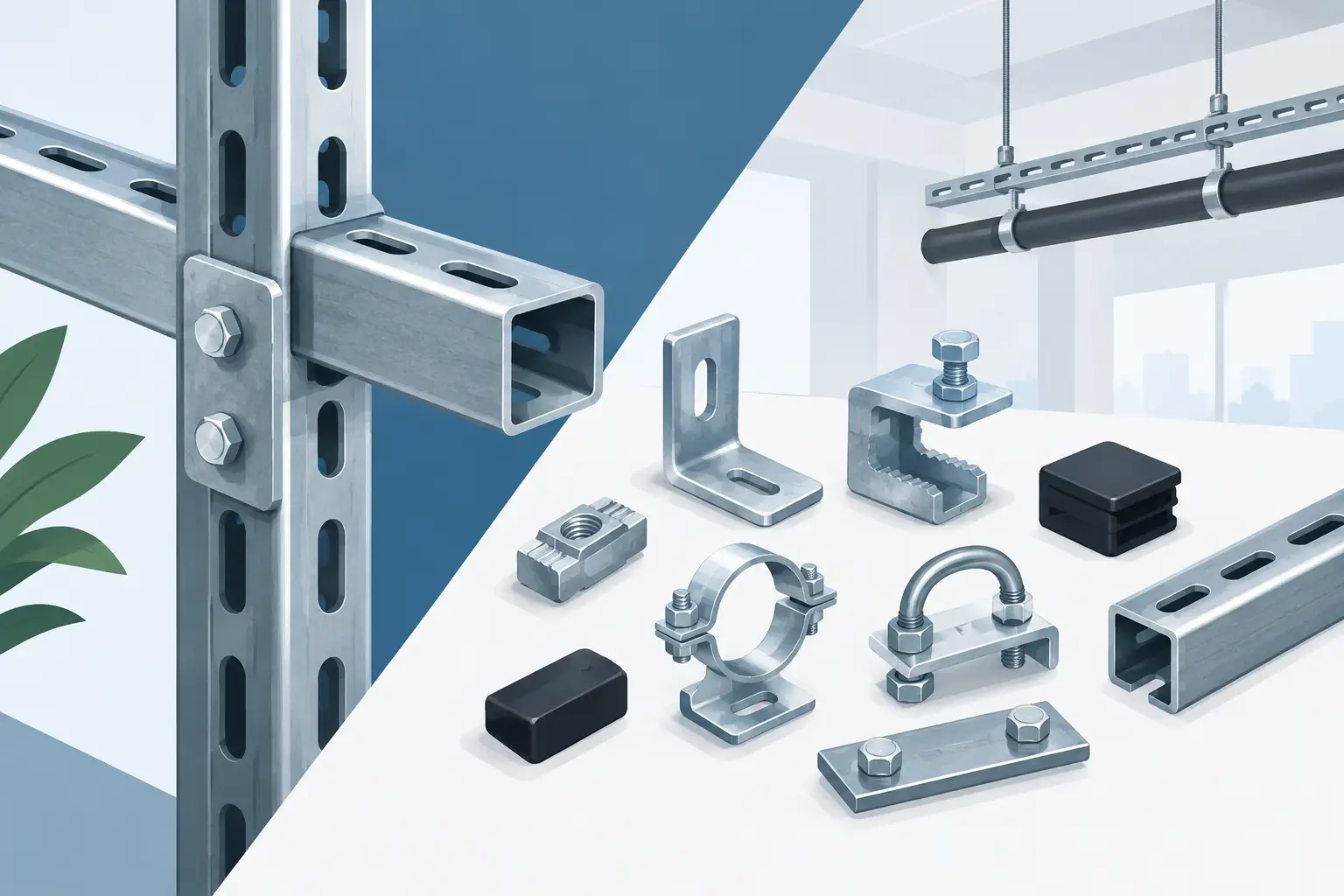
A strut support system is only as dependable as the hardware that joins, supports, and secures it. Strut channel accessories determine how loads move through a framing assembly, how quickly installers can make adjustments, and how well the system performs in corrosive, high-vibration, or high-traffic environments. For contractors, OEMs, distributors, and project procurement teams, selecting the right accessories is not a minor purchasing detail. It is a specification decision that affects installation labor, safety, maintenance, and material availability.
Why Strut Channel Accessories Matter
Strut channel provides a flexible structural framework for pipe runs, conduit, cable tray, HVAC equipment, solar supports, machinery guards, and many other industrial applications. The channel creates the framework, but fittings and fastening hardware create the connection points. A channel installed with incorrectly sized nuts, brackets, or clamps can introduce movement, uneven loading, corrosion exposure, or difficult field rework.
A well-matched system gives installers the ability to position components without welding or drilling at every connection. That flexibility is valuable when site dimensions change, when service access is required, or when additions must be made after initial installation. However, flexibility does not remove the need for disciplined engineering. Load requirements, channel profile, fastener engagement, mounting surface, and environmental conditions must all be considered together.
For purchasing teams, accessory selection also has a supply-chain impact. Standardizing compatible channel, fittings, clamps, nuts, and hardware from a capable manufacturing partner reduces fragmented sourcing and helps maintain consistency across multiple locations or project phases.
The Core Types of Strut Channel Accessories
The most effective way to specify accessories is to start with the connection required rather than the individual part number. This keeps the focus on the assembly's function, load path, and installation method.
Channel Nuts and Spring Nuts
Channel nuts are the primary fastening point within slotted strut channel. They engage the inward-facing lips of the channel and allow bolts, threaded rod fittings, brackets, and other components to be secured without through-drilling the channel. Spring nuts add a retaining spring that holds the nut in position during overhead or vertical installation, reducing the need for an installer to hold multiple components in place.
The right nut must match the channel profile and thread requirement. Thread size, channel depth, tooth design, and material grade all influence fit and holding performance. A nut that appears similar may not engage correctly with a different channel series, so compatibility should be verified rather than assumed.
Angle Fittings, Flat Plates, and Brackets
Angle fittings connect channels at 90-degree or adjustable angles, making them essential for trapeze supports, frames, cantilever assemblies, and equipment stands. Flat plates join sections end to end or provide a broad mounting interface. Post bases, wall brackets, and specialized brackets transfer loads from the strut structure to concrete, steel, wood, or other mounting surfaces.
The trade-off is straightforward: more adjustability can simplify field installation, while a heavier formed or welded bracket may offer greater stiffness for demanding loads. When a project includes repeated assemblies, custom brackets can reduce assembly time by combining functions that would otherwise require several standard fittings.
Pipe Clamps, Conduit Clamps, and Beam Clamps
Clamps secure the supported element to the framing system. Pipe and conduit clamps are selected by outside diameter, service type, and whether insulation, vibration reduction, or expansion movement must be accommodated. Beam clamps attach a support assembly to structural steel, often avoiding field welding or drilling.
Clamp sizing should never be based on nominal pipe size alone. The actual outside diameter, insulation thickness, temperature range, and expected movement matter. A rigid clamp may be appropriate for a stationary conduit run but unsuitable for piping that expands or vibrates in service.
Threaded Rod Hardware and Hangers
Threaded rod, rod couplings, rod hangers, washers, and locking hardware are commonly used in trapeze and suspended support systems. These components allow elevation adjustments and help distribute loads across multiple connection points. Their performance depends on proper thread engagement, nut locking, rod length, and support spacing.
For overhead systems, the connection to the building structure deserves the same attention as the channel assembly itself. Anchors, beam attachments, and hanger hardware must be selected for the substrate and verified for the intended load condition.
Specify for the Load Path, Not Just the Catalog Image
A catalog image can show what a fitting looks like, but it cannot confirm whether it is suitable for a specific assembly. Every strut support design should identify the route that force takes from the supported equipment or service line to the building structure.
Consider the weight of the supported item, including fluid-filled pipe, cable content, insulation, and attached accessories. Then account for point loads, cantilever effects, vibration, wind exposure for outdoor installations, and any seismic or code-driven requirements applicable to the project. A channel may have sufficient capacity while the bracket, nut, anchor, or connection point becomes the limiting component.
Spacing is equally important. Increasing support spacing can reduce material use, but it may increase channel deflection or create unacceptable movement in pipe and cable systems. Closer spacing can improve stability but adds labor and attachment points. The correct balance depends on the application, local requirements, and the equipment being supported.
Material and Finish Should Match the Environment
Material selection has a direct effect on service life and total project cost. Mild steel accessories with a suitable protective finish are often economical for dry indoor settings. Pre-galvanized or hot-dip galvanized steel is commonly considered where moisture exposure, outdoor installation, or industrial conditions increase corrosion risk. Stainless steel may be required for coastal, food-processing, chemical, marine, or washdown environments. Aluminum can offer weight and corrosion advantages in select applications, although galvanic compatibility with adjacent metals must be considered.
Finish selection should be made at the system level. A corrosion-resistant channel paired with unprotected nuts, bolts, or clamps can create weak points that shorten the life of the installation. Fasteners and fittings should be specified to provide compatible corrosion performance throughout the assembly.
It also pays to consider the fabrication process. Cut edges, weld areas, bends, and punched locations may require appropriate finishing or coating control to maintain expected protection. For repeatable industrial programs, documented material grades and finishing requirements help prevent substitutions that look similar but do not perform the same way.
Compatibility Requires More Than a Matching Channel Width
Many projects use strut systems designed around widely recognized channel profiles. Accessories described as compatible with a given system may fit physically, yet dimensional tolerances, slot patterns, lip geometry, gauge thickness, and thread specifications can still affect installation and load performance.
Procurement teams should confirm the channel series, dimensions, slot configuration, fitting hole pattern, and fastener thread before placing a large order. This is especially important when replacement hardware must work with an existing installation or when products from more than one source are being evaluated.
A practical approval process may include a drawing review, sample fit-up, material confirmation, and first-article inspection for custom or high-volume programs. These steps add discipline early and can prevent costly field modifications later.
When Standard Hardware Is Not Enough
Standard accessories work well for many routine support assemblies. Custom fabrication becomes valuable when a project has unusual load requirements, restricted installation space, nonstandard channel dimensions, specialized mounting surfaces, or repeatable assemblies that need fewer individual parts.
A custom strut bracket may combine a formed angle, gusset, mounting plate, and punched hole pattern into one component. This can improve stiffness, reduce installation steps, and create a more consistent finished assembly. The initial engineering effort may be higher than selecting off-the-shelf fittings, but the total installed cost can be lower for large production runs or complex projects.
Manufacturing capability matters here. Accurate cutting, punching, bending, welding, assembly, and surface finishing allow hardware to be produced to defined tolerances while maintaining repeatability across batches. Metallix Exports supports both standard strut system components and custom metal fabrication for buyers who need application-specific hardware with export-ready supply coordination.
Build a Better Procurement Specification
Clear specifications help suppliers quote accurately and help installers receive parts that work together. For a complete strut accessory package, purchasing documents should identify the channel profile, material, finish, fitting dimensions, thread sizes, hole patterns, required quantities, and any packaging or labeling requirements. For custom parts, include drawings, revision controls, critical tolerances, weld requirements, and inspection expectations.
Do not overlook lead time and packaging. Hardware for a large site installation should arrive organized by assembly, area, or release schedule where possible. Mixed or poorly labeled fittings can create avoidable delays even when every component is technically correct.
The best strut support assemblies are not defined by the number of fittings used. They are defined by accurate load planning, compatible components, appropriate corrosion protection, and a supply partner that can deliver consistent hardware when the installation schedule demands it.